When someone sends you a message containing “NSFW”, it can be confusing if you have never seen the abbreviation before. You may wonder whether it is a joke, a warning, or simply another piece of internet slang.
Understanding the nsfw meaning in text is useful because this short abbreviation often acts as a quick warning about the type of content you are about to see.
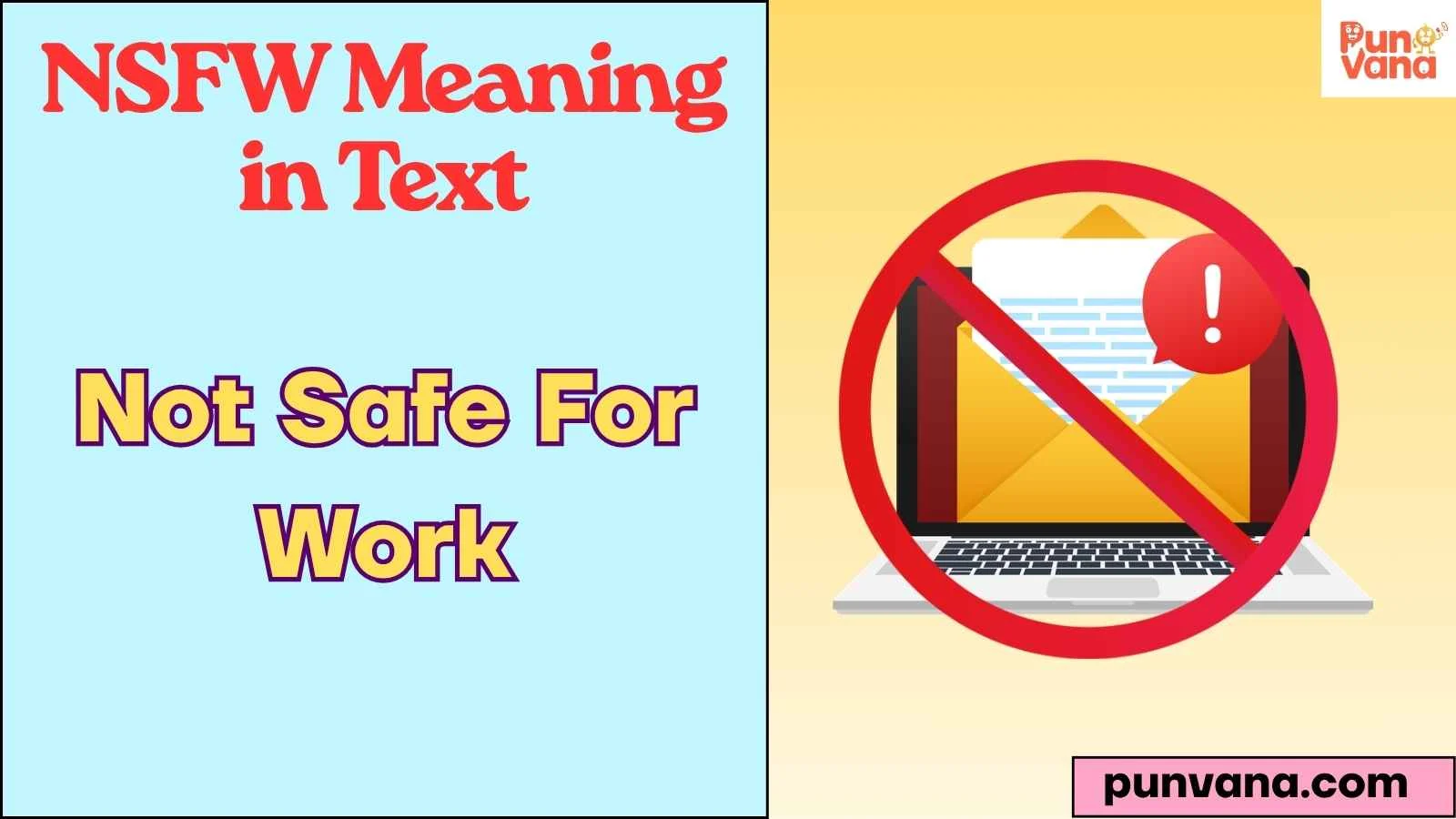
NSFW stands for “Not Safe For Work.” People use it online to warn others that a photo, video, message, website, joke, or post may contain adult, sexual, graphic, offensive, or otherwise inappropriate material.
The warning does not always mean the content is sexual. It can also refer to content that someone may not want to open in a workplace, classroom, public place, or around family.
In simple terms, NSFW means “be careful where you open this.” ⚠️
This guide explains what NSFW means in text, where the term came from, how people use it in messages and social media, what it means in different contexts, and how to respond when someone sends it to you.
What Does NSFW Mean in Text? 💬
The nsfw meaning in text is “Not Safe For Work.”
It is an internet abbreviation used as a content warning. When someone adds NSFW to a message or post, they are telling you that the material may not be suitable for viewing in a professional, public, educational, or family setting.
For example, a person might send:
“NSFW — don’t open this at the office.”
The message does not necessarily tell you exactly what is inside. Instead, it gives you a warning so you can decide whether and where you want to view it.
Simple Definition
| Term | Meaning |
|---|---|
| NSFW | Not Safe For Work |
| Main purpose | Content warning |
| Common setting | Texts, chats, forums, social media |
| Typical content | Adult, sexual, graphic, or offensive material |
| Tone | Usually neutral and cautionary |
| Opposite idea | SFW, meaning Safe For Work |
The abbreviation is especially common in online conversations because it saves time. Rather than writing a long warning, users can simply type NSFW.
What Does NSFW Usually Warn About?
Depending on the context, NSFW may refer to:
- Sexually suggestive material
- Nudity or adult content
- Graphic images
- Violent scenes
- Strong or offensive language
- Disturbing material
- Content unsuitable for children
- Anything awkward to view around coworkers or strangers
Therefore, NSFW does not have only one type of meaning. The exact warning depends on the content and the community where the term appears.
Where Did the Term NSFW Come From? 📜
The abbreviation NSFW developed as internet users needed a quick way to warn one another about content that could cause problems in public or professional environments.
The idea became especially useful as online communities, forums, email groups, and social platforms grew. People began sharing images, jokes, links, and other material that might be inappropriate to open while sitting at work.
Instead of writing a complete warning such as:
“Please do not open this if you are sitting at work because it contains adult material.”
A user could simply write:
“NSFW.”
That short label was much faster.
The phrase “Not Safe For Work” became widely recognized as a general internet warning. Over time, people began using it beyond literal workplaces. Today, NSFW can mean that something is better viewed privately or away from children, coworkers, classrooms, public spaces, or other situations where inappropriate content could create discomfort.
Why Did People Need a Short Warning?
Internet communication moves quickly. Users often share links without explaining every detail. A short warning helps the receiver make an informed choice.
For example:
Without a warning:
“Check this video 😂”
With a warning:
“NSFW — check this later.”
The second version gives the reader more information before they click.
That is one reason the abbreviation remains useful today. 👍
How NSFW Is Used in Text Messages 📱
In texting, NSFW normally works as a warning placed before or after a message, image, video, or link.
It can appear in several forms:
- NSFW
- NSFW!
- NSFW warning
- This is NSFW
- Probably NSFW
- NSFW, open later
- Heads-up: NSFW
- That link is NSFW
The abbreviation is flexible. People may use it seriously, casually, or humorously.
Example 1: A Direct Warning
“NSFW. Don’t open that here.”
This is a straightforward warning. The sender believes the content may be inappropriate for the current environment.
Example 2: A Link Warning
“I found something funny, but it’s NSFW.”
Here, the sender is telling the recipient that the material may not be suitable for work or public viewing.
Example 3: A Group Chat
“Warning: NSFW content below.”
This gives everyone in the conversation a chance to decide whether they want to continue.
Example 4: A Casual Message
“LOL this meme is definitely NSFW 😂”
The sender may be using NSFW casually to describe a meme that contains adult humor or material that could be awkward in a public setting.
Example 5: A Workplace Conversation
“Can you send me a different version? The original image is NSFW.”
Here, NSFW is being used more professionally. The person wants to avoid sharing inappropriate material in a work environment.
What Does NSFW Mean on Social Media? 🌐
On social media, NSFW is commonly used as a label or warning before users view certain posts.
A person might write:
“NSFW warning before you scroll.”
This tells followers that the post may contain material they would not want to see in a workplace, school, public setting, or around family.
Social media platforms also have their own rules regarding adult or sensitive content. Therefore, seeing an NSFW label does not automatically mean that the platform permits every type of content. It simply tells viewers that the material may be unsuitable for some audiences.
Common Social Media Examples
You may see phrases such as:
- NSFW post
- NSFW account
- NSFW image
- NSFW meme
- NSFW thread
- NSFW warning
- NSFW content ahead
- Marked as NSFW
The meaning remains essentially the same: the content may not be appropriate for every setting or audience.
Why Social Media Users Add NSFW Labels
There are several reasons:
- To warn followers
- To avoid surprising viewers
- To separate adult content from general content
- To help people choose whether to continue
- To show awareness of the audience
- To make the nature of a post clearer
A good warning respects the fact that people use their phones in many different places.
Does NSFW Always Mean Sexual Content? 🤔
No. This is one of the most important things to understand about the nsfw meaning in text.
Many people immediately connect NSFW with sexual or adult material. That is common, but NSFW can have a broader meaning.
The label can be used for anything that someone may reasonably consider inappropriate or uncomfortable to view at work or in a public setting.
For example, an extremely graphic image of an accident could be marked NSFW even if it contains no sexual material.
Likewise, a post containing very strong language may sometimes receive an NSFW warning.
NSFW Can Include
| Type of Content | May Be Marked NSFW? |
|---|---|
| Sexual content | Yes |
| Nudity | Yes |
| Adult humor | Sometimes |
| Graphic violence | Yes |
| Disturbing images | Yes |
| Strong language | Sometimes |
| Offensive jokes | Sometimes |
| Ordinary humor | Usually no |
| Family-friendly content | Usually no |
The important point is context.
An NSFW label is best understood as a warning about suitability, not as a precise description of everything contained in the material.
NSFW vs. SFW: What Is the Difference? 🔄
If NSFW means “Not Safe For Work,” then SFW means “Safe For Work.”
SFW is used to indicate that content is generally appropriate to view in a workplace or other public setting.
For example:
“This video is SFW.”
That tells you that the sender believes the video does not contain material that would normally be awkward or inappropriate to watch at work.
Quick Comparison
| Abbreviation | Full Form | General Meaning |
|---|---|---|
| NSFW | Not Safe For Work | May be inappropriate for public or professional settings |
| SFW | Safe For Work | Generally suitable for public or professional settings |
You may also see NSFL, which is a much stronger warning. It usually means “Not Safe For Life” and is commonly associated with extremely disturbing or graphic material.
Because NSFL can involve highly disturbing content, users should treat that warning more seriously than a normal NSFW label.
Common Examples of NSFW in Text 💡
Understanding real conversational examples makes the abbreviation much easier to recognize.
Example 1
Friend: “I found the original version of that meme.”
You: “Send it.”
Friend: “NSFW though.”
Here, the friend is warning you before sending it.
Example 2
“That thread is hilarious but very NSFW.”
This means the thread contains adult or otherwise inappropriate material.
Example 3
“I can’t look at this at work 😂 It’s so NSFW.”
The speaker is saying that the content would be awkward or inappropriate in their workplace.
Example 4
“The image is NSFW, so open it later.”
This is a direct recommendation to wait until the viewer is in a private or suitable environment.
Example 5
“Is this NSFW?”
The person is asking whether the content is inappropriate for a workplace or public environment.
Example 6
“Mark that post NSFW.”
The speaker is suggesting that the post should have a warning.
Example 7
“NSFW warning before you click.”
This is a simple content notice.
Example 8
“The joke itself is fine, but the picture is NSFW.”
This shows how the term can describe one part of a larger post rather than the entire conversation.
How to Understand NSFW Based on Context 🧠
Internet abbreviations can sometimes be confusing because people use them differently. The best way to understand NSFW is to look at the surrounding conversation.
Ask yourself:
1. What is being shared?
Is it an image, video, joke, website, message, or link?
2. Why did the person add NSFW?
They are probably warning you about the content.
3. Where are you seeing it?
A workplace forum may use NSFW more literally, while a meme group may use it casually.
4. What was discussed immediately before it?
The previous messages often explain what kind of warning is intended.
Context Changes the Exact Meaning
For example:
“NSFW meme”
Usually means the meme contains adult, suggestive, offensive, or otherwise unsuitable material.
“NSFW image”
Usually warns that the image may contain nudity, sexual material, graphic content, or something inappropriate for public viewing.
😁“NSFW joke”
Usually means the joke contains adult themes, strong language, or humor that may be awkward in a professional setting.
“NSFW account”
Usually indicates that an account regularly posts adult or otherwise unsuitable material.
The abbreviation remains the same, but the specific reason for the warning depends on the content.
Why People Use NSFW Instead of Writing a Full Warning ⚠️
The biggest advantage of NSFW is speed.
Online conversations often involve short messages, quick replies, and fast-moving group chats. A three- or four-letter abbreviation can communicate a useful warning immediately.
Consider the difference:
Long version:
“Be careful opening this because the image might contain content that would not be appropriate to view at work.”
Short version:
“NSFW.”
The second version is much faster.
Other Reasons People Use It
- It is widely recognized online.
- It saves typing time.
- It gives users a choice before opening content.
- It works across many online communities.
- It is easy to place before a link or image.
- It can prevent awkward situations.
A short warning can be especially helpful when someone is viewing a phone in a public space.
How to Respond When Someone Sends “NSFW” 📲
If someone sends you a message that includes NSFW, you do not need to respond in any special way.
You can simply decide whether you want to open the content.
If you are at work, school, or somewhere public, the safest response may be to wait.
Casual Responses
You could say:
- “Got it 😂”
- “I’ll check it later.”
- “Thanks for the warning.”
- “Not opening that at work!”
- “I’ll save that for later.”
- “Good warning 😄”
If You Want More Information
You can ask:
“What kind of NSFW?”
This gives the sender a chance to explain whether they mean adult humor, graphic material, strong language, or something else.
You can also say:
“Can you describe it first?”
That is useful if you are unsure whether you want to view the content.
If You Do Not Want the Content
You can simply say:
“I’ll pass, thanks.”
There is no need to open something simply because another person sends it.
Is NSFW Rude or Offensive? 🤝
Usually, NSFW itself is not rude or offensive. It is generally a practical warning.
The tone depends on how someone uses it.
For example:
“NSFW warning — open this later.”
This is respectful and informative.
On the other hand:
“NSFW 😂😂 You have to see this!”
This may be playful or teasing.
The abbreviation itself is neutral. The surrounding message creates most of the tone.
A Helpful Rule
Think of NSFW as a digital caution sign. 🚧
It does not necessarily judge the content. It simply warns you that the material may not be suitable for the environment where you are viewing it.
Common Mistakes People Make With NSFW ❌
Even though NSFW is simple, people sometimes misunderstand how it works.
Mistake 1: Assuming It Always Means Sexual Content
NSFW often refers to adult material, but it can also describe graphic, disturbing, offensive, or otherwise unsuitable content.
Mistake 2: Thinking It Means the Content Is Illegal
NSFW does not mean illegal.
It is simply a warning about suitability.
Mistake 3: Assuming It Is Only for Offices
The phrase literally mentions work, but modern usage is broader.
Someone might use NSFW when they mean:
- Not suitable for school
- Not suitable around children
- Not suitable in public
- Not suitable around coworkers
- Better viewed privately
Mistake 4: Ignoring the Warning
If a message says NSFW, do not assume it is harmless just because the sender thinks it is funny.
The label exists so you can make your own choice.
Mistake 5: Treating Every NSFW Label as Identical
Different communities use the term differently. One person may use it for mild adult humor, while another may use it for graphic content.
Context matters.
NSFW Meaning in Different Online Situations 🌍
The phrase can appear across many parts of the internet.
In Text Messages
It acts as a quick warning before a photo, video, or link.
Example:
“NSFW — don’t open that here.”
In Group Chats
It can warn several people at once.
Example:
“NSFW content below. Just a heads-up.”
In Online Forums
It may identify a thread or post that contains adult or graphic material.
In Social Media Posts
It may appear in a caption or content label.
In Emails
Someone may use it in the subject line or message body when sending material that should not be opened in a professional environment.
In Workplace Communication
NSFW is especially important because professional settings usually have stricter expectations about appropriate content.
In Gaming Communities
The term may describe artwork, jokes, chat messages, mods, or other community content that includes adult themes.
In Meme Communities
People may use it more casually to warn about mature jokes or images.
NSFW in a Professional Setting 💼
The phrase “Not Safe For Work” becomes particularly important in professional communication.
Workplaces often have policies about acceptable content, and employees should avoid sending inappropriate material through company systems.
If you receive something labeled NSFW while working, the safest approach is simple:
Do not open it immediately.
Consider whether the content is necessary for your work. If it is not, there may be no reason to view it on a workplace device.
Professional Example
Suppose a colleague writes:
“The original image is NSFW. I attached a clean version instead.”
This is a responsible use of the term because the sender is clearly separating potentially inappropriate material from workplace-friendly material.
In professional communication, clarity is often better than humor.
How NSFW Relates to Digital Etiquette 🌟
Using NSFW responsibly is part of good online etiquette.
A content warning gives another person control over what they see and when they see it.
That small courtesy can prevent uncomfortable situations.
Good NSFW Etiquette
- Give a warning before potentially inappropriate content.
- Do not assume everyone wants to see adult material.
- Respect workplace and community rules.
- Avoid sending inappropriate content to people who did not ask for it.
- Consider the age and setting of your audience.
- Use clearer warnings when the material is especially disturbing.
- Give people an opportunity to opt out.
The best online communication is not only about what you say. It is also about respecting the person receiving it.
NSFW vs. Other Internet Slang and Warnings 🔤
NSFW belongs to a larger group of internet abbreviations that help people communicate quickly.
Here are a few related terms:
| Term | Meaning | Typical Purpose |
|---|---|---|
| NSFW | Not Safe For Work | Warns about potentially unsuitable content |
| SFW | Safe For Work | Indicates generally suitable content |
| NSFL | Not Safe For Life | Strong warning for extremely disturbing material |
| TW | Trigger Warning | Warns about potentially distressing themes |
| CW | Content Warning | Gives notice about potentially sensitive content |
| FYI | For Your Information | Shares information |
| IMO | In My Opinion | Introduces a personal opinion |
These terms are not interchangeable.
For example, TW and CW focus on potentially sensitive or distressing topics, while NSFW generally focuses on whether content is appropriate to view in a professional or public setting.
Understanding the difference can help you interpret online conversations more accurately.
FAQs:
1. What does NSFW mean in text?
NSFW means “Not Safe For Work.” It is an internet abbreviation used to warn that a message, image, video, link, joke, or post may contain content that is inappropriate or uncomfortable to view in a workplace or public setting.
2. Does NSFW always mean something sexual?
No. NSFW often refers to sexual or adult content, but it can also describe graphic violence, disturbing images, offensive language, or other material that may not be suitable for a professional or public environment.
3. What does NSFW mean on social media?
On social media, NSFW is generally a content warning. It tells viewers that a post may contain mature, adult, graphic, or otherwise unsuitable material and may be better viewed privately.
4. What is the opposite of NSFW?
The commonly used opposite is SFW, which means “Safe For Work.” It indicates that content is generally appropriate for viewing in a workplace or public setting.
5. How should I respond when someone says NSFW?
You can simply acknowledge the warning or wait until you are in a private setting. For example, you can say “Thanks for the warning” or “I’ll check it later.” If you are unsure what the warning refers to, ask the sender for more context.
Final Thoughts 📝
The nsfw meaning in text is simple: NSFW stands for “Not Safe For Work.” It is a quick internet warning that tells you content may not be appropriate for a workplace, school, public area, or family setting.
Although people often use NSFW for adult or sexual material, the term can also cover graphic, disturbing, offensive, or otherwise unsuitable content. Context is important, because different communities may use the label in slightly different ways.
The best way to treat NSFW is as a digital caution sign. ⚠️ It gives you a chance to decide whether you want to view something and whether your current surroundings are appropriate.
Once you understand the abbreviation, seeing NSFW in a text, comment, meme, forum, or social media post becomes much easier to understand.

I’m the writer behind Punvana, where I make confusing words, slang, abbreviations, and text meanings simple and easy to understand. I love breaking down language into clear, practical explanations so you can quickly find the meaning and use of any term with confidence.
1 thought on “NSFW Meaning in Text Quick Facts & Fun Context”