PS meaning in text is usually “postscript.” It is a short note added after the main message, often to mention something the writer forgot or wants to emphasize. You may see PS in texts, emails, social media captions, letters, and online chats.
For example:
I’ll see you at 7 tonight. PS: Don’t forget your jacket! 🧥
Here, the main message is about meeting at 7, while the PS adds a quick reminder.
But there is more to this tiny abbreviation than many people realize. Depending on the conversation, PS can have different meanings, tones, and uses. Sometimes it sounds friendly and casual. Other times, it can make a message feel playful, warm, or even slightly dramatic. 😄
If you have ever received a text ending with PS and wondered what the sender meant, you are in the right place. This guide explains the PS meaning in text, where it came from, how people use it today, and how to understand it from context.
What Does PS Mean in Text? 📱
The most common PS meaning in text is postscript.
A postscript is an extra thought placed after the main body of a message. The word comes from Latin roots that relate to something written afterward.
In modern texting, however, you do not need to write a long letter to use PS. People often add it to a quick message when they suddenly remember something important, funny, sweet, or interesting.
For example:
- Thanks for helping me today. PS: You owe me coffee! ☕
- The meeting starts at 10. PS: Bring your notes.
- I had a great time with you. PS: Your story still makes me laugh. 😂
- Dinner was amazing. PS: Send me that recipe!
In each case, the main message is complete before the PS appears.
The simple definition
PS = postscript = an extra note added after the main message.
Think of it as saying:
“Oh, one more thing…”
That is why PS works so naturally in modern communication.
PS Meaning in Text: A Quick Answer
If someone asks, “What does PS mean in texting?”, the safest answer is:
PS usually means “postscript,” an additional thought or note added after the main message.
It can be used to:
- Add a reminder
- Share an extra detail
- Make a joke
- Add emotion
- Emphasize something
- Mention something forgotten
- End a message in a memorable way
Here is a quick reference table:
| Term | Meaning | Common Use |
|---|---|---|
| PS | Postscript | Extra note after a message |
| P.S. | Postscript | Formal or traditional writing |
| PS: | Postscript | Casual texting and online messages |
| PPS | Post-postscript | Another note after PS |
| P.P.S. | Post-postscript | A second extra note |
The exact style does not matter much in casual texting. PS, P.S., and PS: are generally understood in the same way.
Where Did PS Come From? ✍️
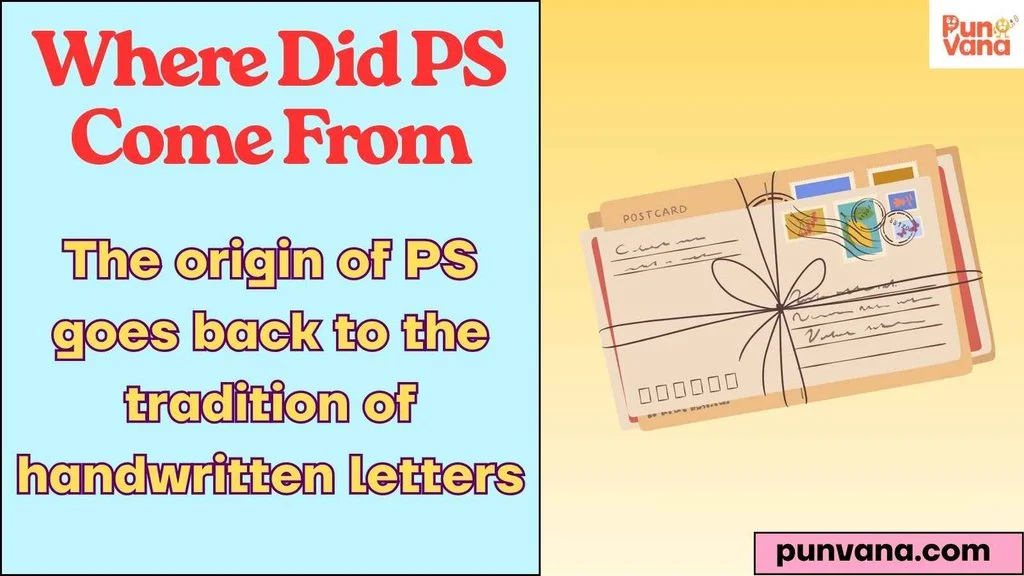
The origin of PS goes back to the tradition of handwritten letters.
Before instant messaging, email, and smartphones, people often wrote letters by hand. After finishing a letter, a writer might suddenly remember an important detail.
Instead of rewriting the entire letter, they added another note at the end.
That additional note became known as a postscript.
The abbreviation PS comes from the term postscript.
Over time, the idea moved from letters into other forms of communication. People began using postscripts in:
- Personal letters
- Business letters
- Greeting cards
- Printed advertisements
- Emails
- Online posts
- Text messages
- Social media
Today, the PS meaning in text has become much more flexible.
A person does not necessarily use PS because they forgot something. They may use it simply because it creates a fun ending.
For example:
Good luck with your exam tomorrow! PS: You’ve got this! 💪
The writer probably did not forget the encouragement. They used PS to give the final sentence extra impact.
Why Do People Use PS in Text Messages? 💬
The beauty of PS meaning in text is its simplicity.
Text messages are usually short. People want to communicate quickly without adding unnecessary explanations. A PS gives them a natural way to add another thought.
1. To add something they forgot
This is the traditional use.
I’ll bring the snacks tomorrow. PS: Can you bring some drinks?
The sender has already finished the main thought but adds another request.
2. To add a reminder
PS works well for reminders because it separates the reminder from the main message.
See you at the restaurant at 8. PS: Parking is behind the building.
3. To add humor
A funny PS can make an ordinary message more entertaining.
Thanks for helping me move. PS: I still haven’t forgiven you for making me carry the couch. 😂
4. To add affection
A PS can make a message feel warmer.
I hope you have an amazing day. PS: I’m really glad we’re friends. ❤️
5. To emphasize something
Sometimes the final thought is the part the sender really wants you to remember.
Please bring your passport tomorrow. PS: Seriously, don’t forget it!
6. To create suspense
People can also use PS to add a small surprise.
I have a surprise planned for Saturday. PS: Wear comfortable shoes. 👀
This makes the message more interesting.
PS Meaning in Texting vs. Traditional Writing
The basic PS meaning in text has not changed much, but the way people use it has.
Traditional writing often used PS because the writer remembered something after completing a letter.
Modern texting is different.
People may use PS even when the extra thought was planned from the beginning.
Consider these two examples.
Traditional style:
Dear Alex,
Thank you for your letter. I hope you are doing well.
PS: Please say hello to your family.
Modern texting style:
Thanks for coming today! Had such a good time. PS: Your dog is officially my new best friend. 🐶😂
The second example is more playful.
That difference shows how PS meaning in text has evolved. It is no longer only about forgetting information. It can also be a stylistic choice.
Comparison table
| Traditional PS | Modern Text PS |
|---|---|
| Often added after a letter | Common in chats and messages |
| Usually used for forgotten details | Often used for jokes or emphasis |
| More formal | Usually casual |
| Longer messages | Often short messages |
| Handwritten or typed | Digital communication |
So, when someone uses PS in a text, focus on the sentence around it rather than assuming they forgot something.
How to Understand PS From Context 🔎
Although PS meaning in text usually refers to postscript, context always matters.
Abbreviations can sometimes have multiple meanings. The surrounding words help you determine what the sender intended.
For example:
I’m sending the documents tonight. PS: Please check page three.
This clearly uses PS as a postscript.
But imagine:
PS is my favorite game console.
That could refer to PlayStation, not postscript.
This is why context matters.
Signs that PS means “postscript”
PS probably means postscript when:
- It appears near the end of a message.
- It is followed by an extra sentence.
- The sentence adds a reminder.
- The sender adds a joke.
- The sender adds a personal thought.
- It follows a completed idea.
Signs that PS may mean something else
PS may have another meaning when:
- It appears before a noun.
- The topic is gaming.
- The conversation discusses technology.
- It refers to a school or workplace abbreviation.
- It appears as part of a product or organization name.
For example:
I bought a new PS yesterday.
In a gaming conversation, PS could easily mean PlayStation.
So, understanding PS meaning in text requires more than looking at the two letters. Always consider the conversation.
Common Examples of PS in Text Messages 📲
The easiest way to understand PS meaning in text is through real-life-style examples.
Friendly example
Thanks for meeting me today! It was great catching up. PS: Let’s not wait another year next time. 😊
The PS adds a friendly suggestion.
Funny example
I’m officially starting my diet tomorrow. PS: The pizza tonight does not count. 🍕😂
Here, PS creates a joke.
Reminder example
I’ll see you at the airport at 6. PS: Bring your ID!
The PS adds an important reminder.
Romantic example
I hope you sleep well tonight. PS: I miss you already. ❤️
The PS adds an emotional touch.
Work example
I’ve attached the updated report. PS: The final page includes the new figures.
This version is practical and professional.
Casual example
Great seeing you today! PS: Send me those photos when you get a chance. 📸
The PS adds another request.
Excited example
We’re going on vacation next month! PS: I already found the perfect hotel. ✈️
The extra sentence builds excitement.
PS Meaning in Text When Used in a Funny Way 😂
One reason PS meaning in text remains popular is that it can deliver a punchline.
A normal sentence may feel complete, but the PS adds an unexpected twist.
For example:
I promise I’ll be responsible this weekend. PS: Ordering dessert is still responsible. 🍰
Or:
Thanks for letting me borrow your car. PS: It now has a very attractive new air freshener. 😂
Or:
I finished all my work today. PS: By “finished,” I mean I looked at it.
The PS becomes almost like a mini punchline.
This works because readers naturally expect the main message to be over. The extra sentence catches their attention.
Why PS works for humor
A PS can create:
- Surprise
- Timing
- Contrast
- Playfulness
- Personality
That makes it especially useful for social media captions and casual chats.
PS Meaning in Text for Social Media and Captions 📸
Social media has made PS even more flexible.
People sometimes use PS at the end of captions to add a small detail, joke, or personal message.
For example:
Weekend well spent with my favorite people. 🌴
PS: We definitely ate too much. 😂
Or:
New city, new memories, same camera roll full of food. 📸
PS: I regret nothing.
Or:
Another year older and hopefully wiser. 🎂
PS: The cake was the real star.
The main caption delivers the message. The PS adds personality.
Good uses of PS in captions
Use PS when you want to:
- Add a funny detail
- Mention something people may have missed
- Add a personal note
- Make the caption more conversational
- End with a memorable line
However, do not force a PS into every caption. It works best when the extra sentence genuinely adds something.
PS vs. P.S. vs. PS: Which One Is Correct?
You may wonder whether you should write PS, P.S., or PS:.
All three can be understood.
P.S.
P.S. is the traditional form.
Example:
P.S. Don’t forget your umbrella. ☔
It looks slightly more formal.
PS
PS is common in digital communication.
Example:
PS don’t forget your umbrella!
It feels more casual.
PS:
PS: is very common online.
Example:
PS: Bring snacks. 🍿
The colon makes the extra note easy to spot.
Which should you use?
For texting, PS: is often the clearest choice.
😁For a formal letter, P.S. may look more traditional.
For casual social media posts, PS or PS: both work.
There is no need to overthink punctuation in everyday texting.
PS Meaning in Text: PS vs. PPS
Sometimes one extra thought is not enough.
That is where PPS comes in.
PPS generally means post-postscript.
It means another note added after the PS.
For example:
PS: Don’t forget your jacket.
PPS: And bring an umbrella too! ☔
The structure is:
Main message → PS → PPS
Historically, people could continue adding postscripts, although that can become cumbersome.
In modern texting, PPS is usually playful.
For example:
PS: Thanks for the gift! 🎁
PPS: I’m already using it.
PPPS: You officially know me too well. 😂
This can create a fun, personal tone.
When Should You Use PS in a Text? ✅
Knowing the PS meaning in text is useful, but knowing when to use it is even more important.
A PS works best when the main message already feels complete.
Use PS when you want to add:
A forgotten detail
I’ll call you later. PS: I’m free after 8.
A reminder
See you tomorrow. PS: Bring the tickets.
A joke
I’m trying to save money. PS: Coffee is obviously essential. ☕
An emotional note
Take care and have a safe trip. PS: I’ll miss you. ❤️
A final thought
Good luck with everything. PS: You’re more prepared than you think.
Avoid using PS when:
- The extra information is extremely important.
- The message would be confusing without it.
- You are writing a highly formal document.
- You are adding several unrelated topics.
- The PS becomes longer than the main message.
If the information is essential, put it in the main body instead.
Examples of PS in Different Situations 🌎
The PS meaning in text stays the same, but the tone can change depending on who you are talking to.
With friends
Dinner was great! PS: Next time, you’re choosing the restaurant. 😂
With family
I’ll be home around 7. PS: Tell Mom I said hi. ❤️
😉With a coworker
I sent the revised file. PS: The updated section is on page four.
With a classmate
Don’t forget about tomorrow’s presentation. PS: Bring your slides on a USB just in case.
With a partner
Hope your day goes well. PS: You’re my favorite person. ❤️
😊With a customer
Thank you for your order. PS: Your package will be sent tomorrow.
On social media
Best weekend ever! 🌅 PS: I took approximately 400 photos.
The abbreviation stays recognizable across all these situations.
What Does PS Mean at the End of a Message? 💡
When PS appears at the end of a message, it almost always signals that the sender has one more thought.
It can be helpful to read it as:
“One more thing…”
For example:
I enjoyed our conversation today. PS: Let’s do it again soon.
You could mentally replace PS with:
“Oh, and one more thing: Let’s do it again soon.”
This is one of the easiest ways to understand the purpose of a postscript.
A PS also draws attention to the sentence that follows it. Because it is visually separated from the main message, readers often notice it quickly.
That makes it useful when you want your final thought to stand out.
Common Mistakes People Make With PS 🚫
Even though PS meaning in text is simple, people sometimes misuse it.
Mistake 1: Using PS for the main point
If something is essential, do not hide it in a PS.
Instead of:
PS: The meeting was moved to Monday.
If that is the most important information, say it directly.
Mistake 2: Making the PS too long
A postscript should usually be short.
If your PS becomes a full paragraph, consider making it part of the main message.
Mistake 3: Adding too many unrelated thoughts
One or two extra points are fine. A list of five unrelated ideas can make the message messy.
Mistake 4: Assuming PS always means postscript
Context matters.
A gaming conversation may use PS to mean PlayStation.
Mistake 5: Overusing it
If every message ends with PS, the effect becomes less special.
Use it when it adds value.
PS Meaning in Text: Useful Alternatives
You do not always need to write PS.
Sometimes another phrase sounds more natural.
Here are some alternatives:
| Alternative | Tone |
|---|---|
| One more thing… | Friendly |
| Oh, and… | Casual |
| Also… | Simple |
| By the way… | Conversational |
| Before I forget… | Natural |
| Quick reminder… | Direct |
| And another thing… | Playful |
| Almost forgot… | Casual |
| One last thing… | Clear |
For example:
PS: Bring your charger.
Could become:
Oh, and bring your charger.
Both communicate the same basic idea.
The choice depends on your personal writing style.
How PS Changes the Tone of a Message 🎭
Small words can change the emotional feel of a message.
PS often makes communication feel more personal because it resembles the way people used to add handwritten notes to letters.
Compare:
Thanks for coming.
with:
Thanks for coming. PS: I had a great time! 😊
The second message feels warmer.
Now compare:
Good luck tomorrow.
with:
Good luck tomorrow. PS: You better impress everyone! 😂
The second version feels more playful.
So, the PS meaning in text is not only about information. It can also influence tone.
PS can make a message feel:
- Friendly 😊
- Warm ❤️
- Funny 😂
- Personal 💬
- Playful 😄
- Memorable ✨
- Emotional 🥰
That flexibility explains why such a short abbreviation remains useful.
FAQs:
What does PS mean in texting?
PS usually means “postscript.” It introduces an extra thought, reminder, joke, or detail after the main message.
Does PS mean something different in texting?
Most of the time, PS means postscript when it appears at the end of a message. However, context can change the meaning. In gaming conversations, for example, PS can refer to PlayStation.
Is PS formal or informal?
It can be either. P.S. has a traditional feel, while PS: is very common in casual texts, chats, and social media.
What does PPS mean?
PPS means “post-postscript.” It adds another note after the PS. It is less common and is often used playfully.
Should I use PS in professional messages?
Yes, but use it carefully. A short, useful PS can work in an email or professional message. However, important business information should normally appear in the main message rather than being hidden in a postscript.
Final Thoughts:
Understanding PS meaning in text is easy once you know its basic purpose. It normally introduces a short message added after the main idea.
Use PS when the extra thought is useful, funny, warm, or worth highlighting. Just remember that context matters, especially when the conversation involves gaming, technology, or other areas where PS may have another meaning.
And if you enjoy learning what popular texting abbreviations really mean, explore more related language and texting guides to make every message easier to understand. 📱💡

I’m the writer behind Punvana, where I make confusing words, slang, abbreviations, and text meanings simple and easy to understand. I love breaking down language into clear, practical explanations so you can quickly find the meaning and use of any term with confidence.
1 thought on “PS Meaning in Text A Quick Guide to Its Use”