
Have you ever received a message that was so funny you wanted to say, “I’m literally laughing”? 😄 That is exactly where ROFL meaning in text becomes useful.
ROFL is a popular piece of internet slang that people use when something makes them laugh extremely hard.
It adds emotion to a conversation without requiring a long explanation.
You may see ROFL in text messages, social media comments, online chats, gaming conversations, memes, and casual group discussions.
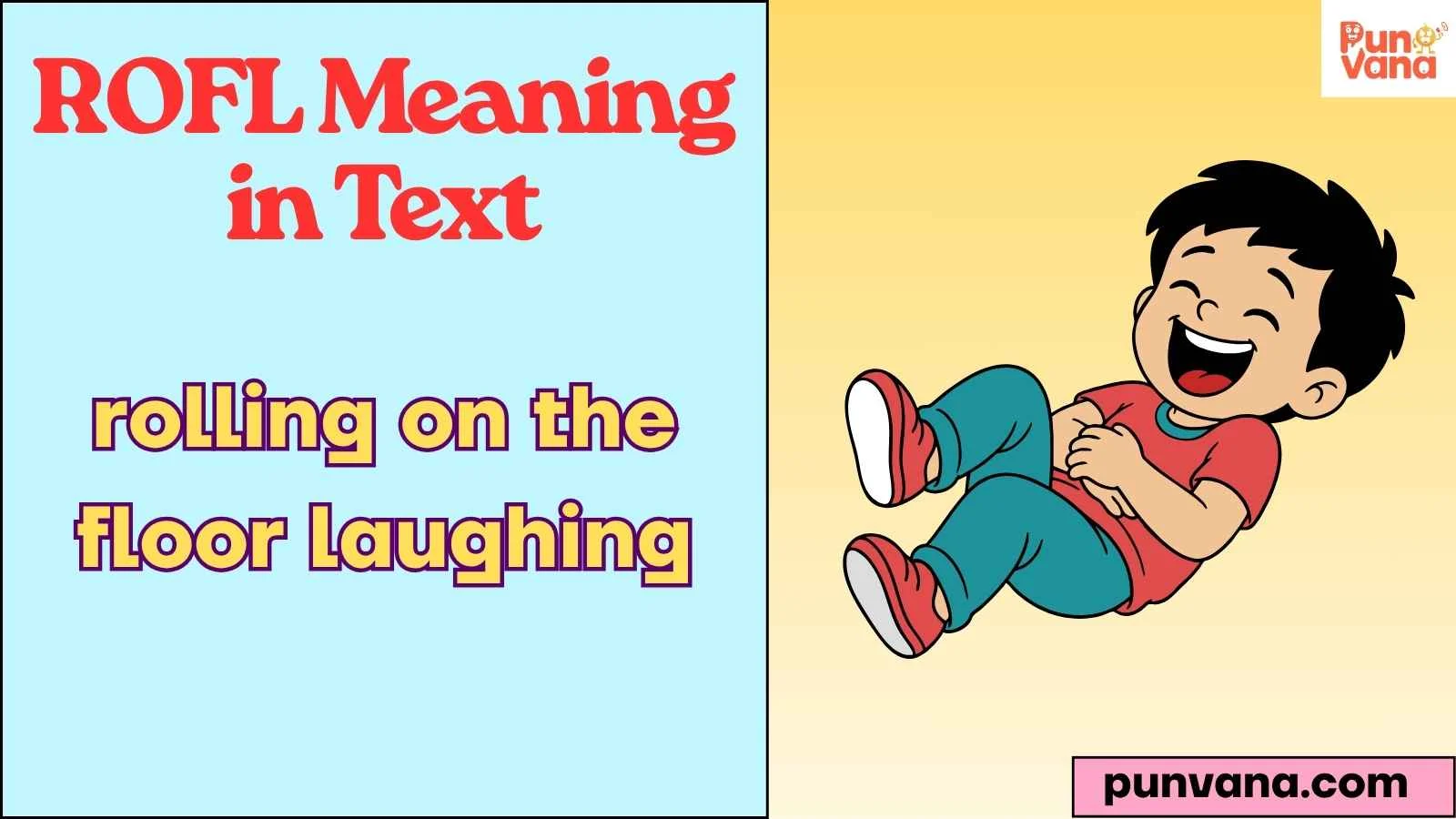
Although the abbreviation looks unusual at first, its meaning is actually simple. ROFL stands for “rolling on the floor laughing.”
Of course, most people do not use it as a literal description of what they are doing. Instead, it works as an expressive way to show that something is extremely funny. 😂
Understanding this abbreviation can make online conversations much easier to follow, especially when people combine it with other expressions such as LOL, LMAO, or LMFAO.
In this guide, you will learn the ROFL meaning in text, its origin, how people use it, what it communicates emotionally, when to use it, and how it compares with other common internet expressions.
What Does ROFL Mean in Text? 🤣
ROFL means “rolling on the floor laughing.”
It is an informal abbreviation used in digital communication to express very strong amusement.
When someone writes ROFL after a message, they usually mean something like:
“That is incredibly funny!”
The phrase is generally stronger than a simple LOL, although the exact intensity depends on the person and the conversation.
For example:
Friend: “I walked into the wrong classroom and sat there for five minutes before realizing it.”
You: “ROFL 😂”
Here, ROFL communicates that you found the situation especially funny.
Quick definition
| Term | Meaning | Typical use |
|---|---|---|
| ROFL | Rolling on the floor laughing | Extremely funny situations |
| LOL | Laughing out loud | General amusement |
| LMAO | Laughing my ass off | Strong amusement |
| LMFAO | Laughing my freaking/fucking ass off | Very strong, highly informal amusement |
The important point is that ROFL is usually figurative. Someone does not necessarily mean they have physically fallen onto the floor.
What Does ROFL Stand For? 🔎
The full form of ROFL is:
R = Rolling
O = On
F = Floor
L = Laughing
Put together:
ROFL = Rolling On the Floor Laughing
The expression paints a humorous picture of someone laughing so hard that they cannot stay upright. Over time, the phrase became shortened into the four-letter abbreviation that people now recognize online.
Like many internet abbreviations, ROFL makes communication faster. Instead of typing a complete sentence such as “That was unbelievably funny,” someone can simply type ROFL.
This is particularly useful in fast-moving conversations where people exchange short messages.
ROFL in a sentence
Here are a few natural examples:
- “ROFL, that was the funniest thing I’ve seen today.”
- “You actually said that to your teacher? ROFL 😂”
- “ROFL! I can’t believe you remembered that.”
- “That meme had me ROFL.”
- “ROFL, your story gets better every time.”
Notice that ROFL can appear at the beginning, middle, or end of a message.
The Origin and History of ROFL 🌐
The phrase behind ROFL became popular during the growth of online communication. As internet chat rooms, instant messaging, forums, and social platforms expanded, users began creating abbreviations that made conversations faster and more expressive.
Before people commonly typed ROFL, phrases describing intense laughter already existed in everyday English. The idea of someone “rolling on the floor laughing” was a humorous exaggeration used to describe uncontrollable amusement.
Internet users eventually transformed the phrase into an abbreviation.
The development followed a familiar pattern:
Long phrase → shortened expression → acronym → internet slang
ROFL became especially recognizable during the early era of online chat and instant messaging. Users wanted quick ways to communicate reactions without typing full sentences.
The abbreviation also fit naturally alongside expressions such as:
- LOL
- LMAO
- BRB
- OMG
- WTF
These abbreviations became part of the informal language of digital communication.
Today, ROFL is widely understood by many English-speaking internet users. However, its popularity can vary depending on age group, platform, region, and personal texting style.
How Is ROFL Used in Text Messages? 💬
The ROFL meaning in text depends slightly on context, but its main purpose remains the same: to communicate strong amusement.
People commonly use ROFL after:
- A funny joke
- An embarrassing but harmless story
- A clever response
- A funny meme
- A surprising comment
- An amusing mistake
- A ridiculous situation
- A humorous video
- A playful insult between friends
For example:
Person A: “I tried cooking pasta and somehow burned the water.”
Person B: “ROFL 😂”
The second person is using ROFL to show that the statement was unexpectedly funny.
ROFL can also strengthen a response
Compare these messages:
“LOL.”
and
“ROFL 😂😂”
The second one generally feels more energetic. It suggests that the person found the situation particularly amusing.
However, there is no strict mathematical scale for internet laughter. One person’s ROFL might be another person’s LOL. Context matters.
ROFL Examples in Everyday Conversations 😂
Learning slang becomes easier when you see it in realistic situations.
Example 1: Funny mistake
Friend: “I sent my grocery list to the group chat instead of my homework.”
Response: “ROFL. What did everyone say?”
The abbreviation shows amusement while keeping the conversation moving.
Example 2: A funny memory
Friend: “Remember when we spent ten minutes looking for the phone that was in my hand?”
Response: “ROFL 😂 Yes!”
Here, ROFL emphasizes that the memory is particularly funny.
Example 3: A clever joke
Friend: “My alarm clock and I have a very toxic relationship.”
Response: “ROFL, that’s actually accurate.”
ROFL works naturally with humorous observations.
Example 4: Online comments
Someone may post:
“This comment section is ROFL material.”
That means the person thinks the comments are extremely funny.
Example 5: Group chats
Friend 1: “I just watched the same tutorial three times and still don’t understand it.”
Friend 2: “ROFL, at least you’re committed.”
The abbreviation makes the response sound playful rather than formal.
ROFL vs. LOL: What’s the Difference? 😄
One of the most common questions about ROFL meaning in text is how it differs from LOL.
Both expressions communicate laughter, but they can suggest different levels of amusement.
LOL stands for “laughing out loud.”
It is one of the most common internet abbreviations and can indicate anything from a genuine laugh to mild amusement.
ROFL, on the other hand, literally describes a much more dramatic reaction: “rolling on the floor laughing.”
Consider this example:
“That’s funny, LOL.”
This sounds casual.
Now compare:
“That’s hilarious, ROFL!”
This sounds more enthusiastic.
Still, people do not always follow this distinction strictly. Someone might use LOL for something extremely funny or ROFL for a relatively small joke.
Simple comparison
| Expression | Full form | General feeling |
| LOL | Laughing out loud | Amused |
| ROFL | Rolling on the floor laughing | Very amused |
| LMAO | Laughing my ass off | Strong amusement |
| LMFAO | Laughing my freaking/fucking ass off | Very strong and highly informal |
So, if you want a simple rule:
LOL = funny
ROFL = extremely funny
But remember that online slang is flexible.
ROFL vs. LMAO and LMFAO 🤔
ROFL is also frequently compared with LMAO and LMFAO.
LMAO is another expression of strong laughter. It is more informal and contains profanity in its literal expansion, although many people use the abbreviation casually without thinking about the full phrase.
LMFAO intensifies the same basic idea.
ROFL differs because its literal phrase is comparatively clean:
ROFL = Rolling On the Floor Laughing
That makes ROFL useful when someone wants to express strong amusement without using profanity in the abbreviation itself.
For example:
“That video was ROFL.”
or
“I was ROFL when I read your message.”
Meanwhile, LMAO tends to sound more casual and sometimes more emphatic.
Which one should you use?
It depends on the conversation.
Use LOL for ordinary casual amusement.
Use ROFL when you want to emphasize that something is exceptionally funny.
Use LMAO in very casual conversations where that style fits.
Use LMFAO when you want an even more exaggerated reaction.
The best choice is always the one that matches the tone of the conversation.
Does ROFL Literally Mean Someone Is on the Floor? 😂
Usually, no.
ROFL is generally an exaggerated expression rather than a literal statement.
When someone types:
“ROFL!”
they normally mean:
“That is really funny.”
They are not necessarily telling you that they physically rolled across a floor.
Internet slang often uses exaggeration to communicate emotion. For example, people might say:
- “I died laughing.”
- “I’m crying.”
- “I’m screaming.”
- “That destroyed me.”
- “I’m rolling.”
These expressions are commonly understood as figurative reactions to humor.
ROFL works in the same way.
Its strength comes partly from the exaggerated mental image. Instead of simply laughing, the phrase imagines someone laughing so hard that they end up rolling around on the floor.
That exaggeration makes the expression memorable.
When Should You Use ROFL? 📱
ROFL is best suited to informal communication.
You might use it when chatting with:
- Friends
- Classmates
- Family members
- Online communities
- Gaming groups
- Social media followers
- People you regularly communicate with casually
It can work particularly well when responding to something genuinely funny.
Good situations for ROFL
A funny meme:
“ROFL, this meme is perfect.”
A ridiculous story:
“ROFL, how did that even happen?”
A clever joke:
“ROFL 😂 That was actually good.”
A funny mistake:
“ROFL, you really did that?”
A humorous video:
“ROFL, I wasn’t expecting that ending.”
When ROFL may not be appropriate
Because ROFL is informal, avoid using it in situations that require professional or formal communication.
For example, you probably would not write:
“ROFL, thanks for reviewing my application.”
A professional response would usually be clearer and more appropriate.
The key lesson is simple:
ROFL belongs mainly in relaxed digital conversations.
Can ROFL Sound Sarcastic? 😏
Yes. Like many text-based expressions, ROFL can sometimes be sarcastic.
Tone is difficult to communicate through plain text. The same abbreviation can have different meanings depending on the surrounding words.
For example:
“ROFL, great job.”
If someone genuinely made a funny mistake, this might be playful.
But in another context, the same message could sound mocking.
This is why context matters.
People often use punctuation, emojis, or additional words to clarify their intention:
- “ROFL 😂”
- “ROFL, that’s actually hilarious.”
- “ROFL I’m kidding.”
- “ROFL, no way!”
These additions can make the emotional meaning easier to understand.
ROFL and playful teasing
Friends may also use ROFL while teasing each other.
Friend: “I spent an hour looking for my glasses.”
You: “ROFL. They were on your head, weren’t they?”
The response is humorous, but it does not necessarily mean the person is being cruel. In friendly relationships, this kind of teasing can be normal.
Still, it is important to consider the relationship and situation before assuming someone will interpret the expression positively.
ROFL in Social Media, Gaming, and Online Communities 🎮
The ROFL meaning in text stays basically the same across platforms, but its style can change.
Social media
On social platforms, ROFL may appear in:
- Comments
- Captions
- Replies
- Private messages
- Group conversations
Example:
“ROFL, the replies are even funnier than the original post.”
Gaming
Gamers often use short abbreviations because conversations can move quickly.
A player might write:
“ROFL, that was unexpected.”
The abbreviation lets them communicate amusement without typing a longer response.
Group chats
Group chats are another natural environment for ROFL.
When several people are joking at once, a short reaction can communicate a lot.
“ROFL 😂”
can function almost like a verbal laugh.
Online communities
Different communities develop different communication styles. Some prefer abbreviations heavily, while others use more complete sentences.
Therefore, it is useful to observe how people around you communicate before using unfamiliar slang frequently.
How to Reply When Someone Says ROFL 💬
If someone sends you ROFL, you do not necessarily need to reply with another abbreviation.
Your response can depend on the conversation.
If you want to continue the joke
“I knew you’d find that funny 😂”
If you want to add another funny detail
“And that’s not even the funniest part!”
If you want to acknowledge their reaction
“Glad that made you laugh!”
If you also found it funny
“ROFL too 😂”
If you want to keep things simple
“😂😂”
Sometimes an emoji is enough.
There is no required response to ROFL. Digital conversations are flexible, and a natural response is usually better than forcing another slang abbreviation into the conversation.
Common Variations of ROFL 🔤
People sometimes modify ROFL for emphasis.
Here are some forms you may encounter:
| Version | General meaning |
| ROFL | Rolling on the floor laughing |
| ROFLMAO | ROFL combined with LMAO |
| ROFL 😂 | Strong amusement with an emoji |
| ROFL!!! | Extra emphasis |
| rofl | Same meaning in lowercase |
| ROFLing | Informal variation suggesting someone is laughing hard |
The capitalization does not normally change the basic meaning.
ROFL, rofl, and RoFL can all refer to the same expression.
People choose a style based on personal preference, keyboard habits, or the tone they want.
ROFL in Lowercase vs. Uppercase: Does It Matter? ⌨️
Not usually.
You may see:
ROFL
or
rofl
Both generally mean “rolling on the floor laughing.”
Uppercase can sometimes make the reaction feel more noticeable:
“ROFL!!!”
Lowercase can feel more relaxed:
“rofl that was funny”
Neither version is automatically correct or incorrect.
Texting language does not follow the same capitalization rules as formal writing. People often type quickly and use whatever style feels natural.
A useful rule
If you are chatting casually, either form is fine.
If you are writing something formal, it is better to replace the abbreviation with a complete phrase such as:
“That was extremely funny.”
Why Do People Use ROFL Instead of Writing “That’s Funny”? 🧠
Digital communication has changed how people express emotion.
When people talk face-to-face, laughter, facial expressions, gestures, and voice tone provide additional information. Text messages do not offer all of those signals.
Abbreviations such as ROFL help fill that gap.
Instead of writing:
“I found your joke exceptionally funny.”
someone can simply type:
“ROFL 😂”
The shorter expression feels more natural in casual digital communication.
ROFL also creates emotional emphasis. It does not merely say that something is amusing. It communicates an enthusiastic reaction.
This is especially useful in:
- Fast conversations
- Group chats
- Comment sections
- Gaming chats
- Meme discussions
- Casual messaging
In this sense, ROFL is not simply an abbreviation. It functions as a digital emotional cue.
Common Mistakes When Using ROFL 🚫
Although ROFL is simple, people can still misuse it.
Using it in formal communication
ROFL usually does not belong in formal emails, academic assignments, official documents, or professional applications.
Instead, use standard language.
Using it after serious news
Context matters. A laughter abbreviation can seem insensitive if someone is discussing a serious or upsetting topic.
Before using ROFL, make sure the conversation is actually humorous.
Assuming everyone uses slang the same way
Not everyone interprets internet slang identically.
Some people use ROFL frequently. Others prefer LOL, emojis, or complete sentences.
Overusing it
If every message ends with ROFL, the expression may lose its impact.
Use it when the reaction genuinely fits.
Misreading sarcasm
ROFL can occasionally be sarcastic. Look at the surrounding message instead of interpreting the abbreviation alone.
ROFL Meaning in Text: Quick Examples Table 📊
| Text message | What ROFL communicates |
| “ROFL, that joke was perfect.” | Strong amusement |
| “You actually did that? ROFL!” | Amused surprise |
| “ROFL 😂 I can’t believe this.” | Very strong laughter |
| “That meme has me ROFL.” | The meme is extremely funny |
| “ROFL, tell me what happened next.” | Amusement plus interest |
| “I was ROFL at that comment.” | The comment caused strong laughter |
| “rofl that’s hilarious” | Casual amusement |
| “ROFL!!!” | Highly enthusiastic laughter |
These examples demonstrate why context remains important. The abbreviation itself communicates laughter, while the surrounding words explain why the person is laughing.
Related Internet Slang You Should Know 📚
If you understand ROFL, you will probably encounter several related expressions.
LOL
LOL = Laughing Out Loud
It is one of the most common expressions of amusement in online conversations.
LMAO
LMAO expresses strong laughter and is highly informal.
LMFAO
This is an intensified form of LMAO and is even more casual.
Haha
Unlike an acronym, haha directly represents written laughter.
People can modify it for tone:
- “ha”
- “haha”
- “hahaha”
- “HAHAHA”
The number of letters can sometimes suggest the intensity or style of the reaction.
😂
The laughing emoji is often used instead of an abbreviation or alongside one.
For example:
“ROFL 😂”
combines text slang with a visual emotional cue.
OMG
OMG = Oh My God
It usually expresses surprise, excitement, shock, or disbelief rather than laughter specifically.
Understanding these expressions helps you read online conversations more naturally.
Is ROFL Still Used Today? 📱
Yes, people still recognize and use ROFL in digital communication.
However, the popularity of individual slang terms changes over time. Internet language is constantly evolving.
Some users may prefer newer expressions, emojis, reaction images, GIFs, or platform-specific slang. Others continue using familiar abbreviations such as ROFL because they are easy to understand.
The important thing is not whether ROFL is the newest expression. The important thing is that its meaning remains recognizable in many informal online conversations.
Language changes, but useful expressions can remain relevant for years.
ROFL is a good example of how an abbreviation can move from early internet culture into broader everyday digital communication.
FAQs:
What does ROFL mean in text?
ROFL means “rolling on the floor laughing.” People use it in informal digital conversations to show that something is extremely funny or amusing.
Is ROFL stronger than LOL?
Generally, yes. ROFL suggests a more exaggerated reaction than LOL. However, people use internet slang differently, so the actual intensity depends on the person and context.
Is ROFL appropriate for formal messages?
Usually, no. ROFL is informal internet slang. For professional, academic, or formal communication, use standard language instead.
What is the difference between ROFL and LMAO?
Both express strong amusement. ROFL stands for “rolling on the floor laughing,” while LMAO is another highly informal expression meaning that someone is laughing very hard.
Can ROFL be sarcastic?
Yes. Like many text expressions, ROFL can sometimes be used sarcastically. The surrounding words, relationship between speakers, and overall context help determine the intended tone.
Final Thoughts:
Understanding the ROFL meaning in text is simple once you know the phrase behind the abbreviation. ROFL stands for “rolling on the floor laughing,” and people generally use it to express strong amusement in casual digital conversations.
It can appear in texts, group chats, social media comments, gaming conversations, memes, and other informal online spaces. While ROFL often suggests a stronger reaction than LOL, there is no strict rule governing how intensely someone must laugh before using it.
The most important thing is context. ROFL works best when the conversation is genuinely lighthearted and informal. It can make a response feel more energetic, playful, and expressive, but it is not normally suitable for formal communication.
Once you understand ROFL alongside expressions such as LOL, LMAO, and LMFAO, online conversations become much easier to interpret. 💬😂

I’m the writer behind Punvana, where I make confusing words, slang, abbreviations, and text meanings simple and easy to understand. I love breaking down language into clear, practical explanations so you can quickly find the meaning and use of any term with confidence.
1 thought on “ROFL Meaning in Text Quick Relief From Confusion”