Have you ever opened a text message or social media comment and seen someone write “TF”? 🤔 If so, you’re not alone. Internet slang changes quickly, and new abbreviations appear almost every day.
Some are easy to understand, while others can leave you wondering what the sender actually meant.
The TF meaning in text depends on the conversation, the relationship between the people chatting, and the platform where it’s used. In many cases, TF adds emotion, surprise, confusion, or emphasis to a sentence.
It is one of those short internet expressions that has become common across texting apps, social media, online gaming, and casual conversations.
Knowing what TF means helps you avoid misunderstandings and communicate more naturally online. Whether you’re chatting with friends, scrolling through social media, or reading comments on videos, you’ll likely come across this abbreviation sooner or later.
In this complete guide, you’ll learn what TF means in text, where it came from, how people use it, common examples, different meanings, and when you should or shouldn’t use it. By the end, you’ll feel confident whenever you see TF in a conversation. 😊
What Does TF Mean in Text? 📱
Quick Answer
TF usually stands for “the f*” and is commonly used to express surprise, confusion, disbelief, frustration, or strong emphasis in casual online conversations.**
People often use it to make their emotions stronger without typing the full phrase.
For example:
- What TF just happened?
- Where TF are you?
- Why TF did that happen?
- Who TF said that?
In these examples, TF doesn’t change the actual question. Instead, it makes the emotion much stronger.
Featured Snippet Table
| Abbreviation | Meaning | Emotion | Formal? |
|---|---|---|---|
| TF | The f*** | Surprise, anger, confusion, emphasis | ❌ No |
| TF | Too Funny (rare) | Humor | ⚠️ Sometimes |
| TF | Team Fortress (gaming) | Gaming reference | ✅ Context-based |
| TF | Transfer Function (technical) | Engineering | ✅ Yes |
Although “the f*”** is the most common TF meaning in text, always consider the surrounding conversation before deciding what it means.
The Origin of TF in Online Conversations 🌐
Like many internet abbreviations, TF became popular because people wanted a faster way to type emotional expressions. Instead of writing a longer phrase, users shortened it to just two letters.
As texting became more common, abbreviations helped people save time. Character limits on older messaging platforms also encouraged shorter words and phrases.
Soon, TF spread across:
- 📱 SMS texting
- 💬 Messaging apps
- 📷 Social media
- 🎮 Gaming chats
- 🖥️ Online forums
- 🎥 Video comments
Today, millions of internet users recognize TF instantly.
Its popularity continues because it is:
- Easy to type
- Instantly recognizable
- Expressive
- Flexible in many situations
Unlike some internet slang that fades away, TF has remained widely understood for years.
Different Meanings of TF in Text Messages 💡
Although most people think of one meaning first, TF can actually represent several different phrases depending on the situation.
1. “The F***” (Most Common)
This is the meaning you’ll encounter most often.
People use it to show:
- Surprise 😲
- Anger 😠
- Frustration 😩
- Shock 😮
- Confusion 🤯
Examples:
- What TF happened?
- Why TF is it raining again?
- Where TF did everyone go?
- Who TF opened my package?
Notice how TF strengthens the emotion rather than changing the sentence’s meaning.
2. Too Funny 😂
Sometimes people use TF to mean “Too Funny.”
Example:
Friend:
I accidentally wore two different shoes today.
Reply:
TF 😂
Although this meaning exists, it is far less common than the first one.
3. Team Fortress 🎮
Among gamers, TF often refers to the popular multiplayer game Team Fortress.
Examples:
- Want to play TF tonight?
- TF has a new update.
- I started playing TF years ago.
In gaming communities, the meaning is usually obvious from the conversation.
4. Technical Meanings ⚙️
Outside casual texting, TF may stand for different technical terms.
Examples include:
| Field | TF Meaning |
|---|---|
| Engineering | Transfer Function |
| Finance | Trust Fund |
| Education | Teaching Fellow |
| Medicine | Transferrin |
| Science | Transcription Factor |
These meanings appear mainly in professional or academic settings rather than everyday chats.
How TF Is Used in Everyday Text Conversations 💬
One reason TF meaning in text is so common is that it fits naturally into many types of conversations.
Here are some everyday examples.
Expressing Surprise
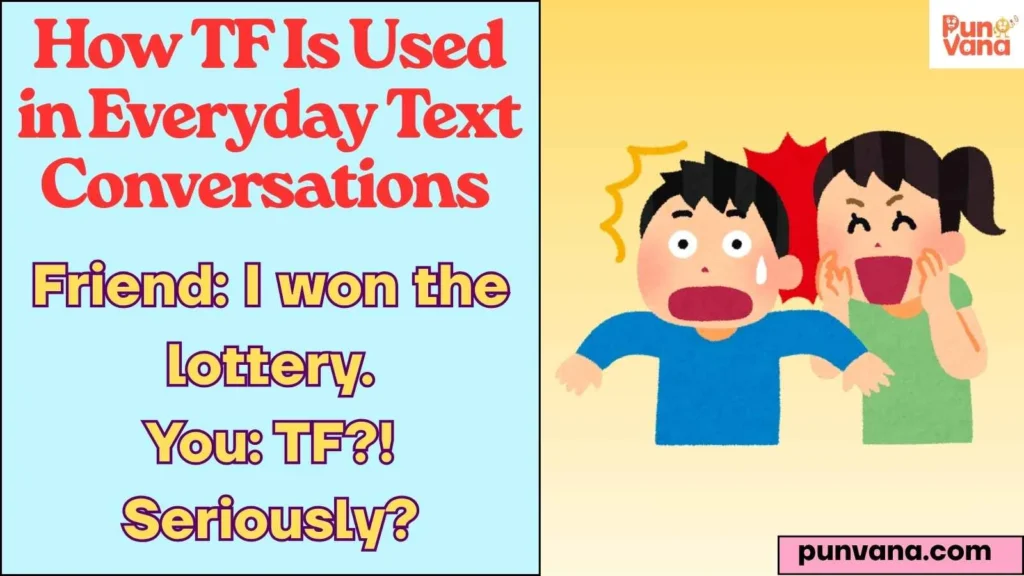
Friend: I won the lottery.
You: TF?! Seriously?
Showing Confusion
I have no idea what TF is happening.
Expressing Frustration
Where TF is my phone?
Reacting to Strange News
What TF did I just read?
Asking an Emotional Question
Why TF would someone do that?
Responding to Unexpected Events
TF… I didn’t see that coming.
Notice something interesting?
The abbreviation usually appears in:
- Questions
- Emotional reactions
- Quick replies
- Social media comments
- Group chats
It rarely appears in formal writing.
TF Meaning on Different Social Media Platforms 📱
The TF meaning in text usually stays the same across most platforms, but the tone can change depending on where people are chatting. Understanding the platform helps you interpret the message more accurately.
TF on Snapchat 👻
Snapchat conversations are usually quick, casual, and personal. Here, TF is often used to react instantly to something surprising or confusing.
Examples:
- What TF are you doing? 😂
- Where TF did you disappear?
- TF just happened?
Since Snapchat messages are informal, people often use abbreviations without worrying about grammar.
TF on Instagram 📸
On Instagram, you’ll often find TF in comments, captions, or direct messages.
Examples:
- TF is this outfit? 😅
- What TF did I just watch?
- That ending was TF wild!
Sometimes creators also use it in memes to make reactions feel stronger.
TF on TikTok 🎵
TikTok is filled with reaction videos, trends, and funny clips. As a result, TF appears frequently in comments.
Examples:
- TF did I just watch?
- What TF is going on here?
- TF 😂😂😂
Because TikTok moves quickly, short expressions like TF help users react instantly.
TF on Facebook 👍
Facebook users of different age groups use TF in comments, private chats, and community discussions.
Examples include:
- Where TF did everyone go?
- What TF happened here?
- Why TF is this trending?
Compared to TikTok or Snapchat, Facebook conversations may be slightly more detailed, but TF still carries the same emotional emphasis.
TF on X (Formerly Twitter) 🐦
Short posts encourage abbreviations.
Examples:
- TF is happening today?
- What TF…
- Why TF is this still trending?
Because posts are brief, abbreviations like TF fit naturally.
TF on WhatsApp 💬
WhatsApp conversations usually happen between family members, friends, classmates, or coworkers.
Examples:
- TF are you?
- What TF happened yesterday?
- Why TF didn’t you call me?
Remember that WhatsApp also includes work groups. In professional conversations, it’s usually best to avoid slang that could sound offensive.
How to Understand the Meaning of TF from Context 🧩
One important rule about internet slang is that context matters.
Although TF most commonly means “the f*,”** the surrounding conversation tells you exactly how it’s being used.
Ask yourself these questions:
Is the conversation emotional?
If someone seems surprised, confused, or frustrated, TF probably adds emphasis.
Example:
“I can’t believe TF happened.”
Is it about gaming?
If players are discussing online games, TF could refer to Team Fortress.
Example:
“I’m downloading TF tonight.”
Is it work or school related?
Professional discussions may use TF for technical terms.
Example:
“The TF equation explains the system.”
Is it meant as a joke?
Sometimes people simply use TF for humorous exaggeration.
Example:
“TF 😂 I wasn’t expecting that.”
Reading the entire conversation before interpreting the abbreviation helps avoid misunderstanding the message.
Common Examples of TF in Text Conversations 💬
Below are realistic examples showing how TF meaning in text changes depending on the situation.
| Text Message | Meaning |
|---|---|
| What TF happened? | Expressing shock |
| Where TF are you? | Showing frustration |
| Why TF is this so expensive? | Complaining |
| Who TF said that? | Surprise or disbelief |
| TF 😂 | Finding something hilarious |
| I’m playing TF tonight. | Talking about Team Fortress |
| TF just crashed again. | Gaming or technical context |
| What TF did I just read? | Confusion |
| TF is going on? | Trying to understand something |
| Why TF didn’t anyone tell me? | Disappointment |
Notice how the words around TF make the intended meaning clear.
When Should You Use TF? ✅
Because TF often contains implied profanity, it’s best to use it only in appropriate situations.
Good situations include:
- 😊 Casual chats with close friends
- 😂 Funny group conversations
- 🎮 Gaming communities
- 📱 Personal text messages
- 🎭 Memes and reaction posts
- 💬 Informal online discussions
In these settings, people generally understand the abbreviation and its emotional tone.
When You Should Avoid Using TF 🚫
Even though the TF meaning in text is widely recognized, it isn’t suitable everywhere.
Avoid using TF in:
- 💼 Business emails
- 🏢 Workplace chats
- 🎓 School assignments
- 📑 Professional reports
- 📧 Messages to clients
- 👩🏫 Conversations with teachers
- 📄 Job applications
- 🤝 Formal communication
Using slang in professional settings can make your writing appear careless or disrespectful.
Instead, choose clearer alternatives such as:
- What happened?
- I’m confused.
- That’s surprising.
- Really?
- I can’t believe it.
These phrases communicate your thoughts without sounding overly casual.
Similar Slang Terms You Might See Alongside TF 🔤
Internet slang evolves constantly, and TF often appears with other popular abbreviations.
| Slang | Meaning | Common Use |
|---|---|---|
| WTF | What the f*** | Surprise or shock |
| FR | For Real | Agreement or emphasis |
| IMO | In My Opinion | Sharing thoughts |
| TBH | To Be Honest | Giving an honest opinion |
| SMH | Shaking My Head | Disappointment |
| IDK | I Don’t Know | Uncertainty |
| BRB | Be Right Back | Temporary absence |
| LMK | Let Me Know | Requesting information |
| OMG | Oh My God | Surprise |
| FWIW | For What It’s Worth | Offering an opinion |
Learning these abbreviations together makes it easier to understand modern online conversations.
TF vs. WTF: What’s the Difference? 🤔
Many people confuse TF with WTF, but they are not exactly the same.
| TF | WTF |
|---|---|
| Usually adds emphasis to a sentence | Is a complete expression |
| Appears inside questions | Often stands alone as a reaction |
| Slightly shorter | More widely recognized |
| Depends on surrounding words | Clearly expresses shock by itself |
Example
TF:
- Where TF are my keys?
WTF:
- WTF just happened?
Both express strong emotion, but WTF is more direct, while TF is often inserted into another sentence for emphasis.
Common Mistakes People Make When Using TF ⚠️
Understanding the TF meaning in text also means knowing what not to do.
Assuming It Always Means One Thing
Although “the f***” is the most common meaning, TF can also refer to gaming, education, finance, or technical subjects.
Always check the conversation before deciding.
Using It in Formal Writing
TF belongs in casual communication, not professional documents or academic work.
Overusing It
Adding TF to every message can make conversations sound repetitive or overly emotional.
Use it only when it genuinely adds emphasis.
Misreading the Tone
A friend may use TF jokingly, while another person may use it out of real frustration. Reading the full message helps you understand the intended emotion.
TF in Pop Culture and Internet Culture 🌍
The TF meaning in text has become part of everyday internet language because people naturally look for faster ways to express emotions online. From viral memes to short-form videos and group chats, TF appears almost everywhere.
You’ll often see it used in:
- 😂 Funny memes
- 🎥 Viral video comments
- 🎮 Gaming communities
- 💬 Group chats
- 📱 Text messages
- 📸 Social media captions
- 🗨️ Online discussions
In many cases, TF isn’t meant to offend anyone. Instead, it acts as a quick emotional reaction that makes a message feel more expressive.
For example:
“TF did I just watch? 😂”
This simple comment instantly communicates surprise and amusement without needing a long explanation.
As internet communication continues to evolve, abbreviations like TF remain popular because they are short, recognizable, and easy to understand.
Why Do People Use TF Instead of Writing the Full Phrase? 🤷
Typing habits have changed dramatically over the years. Most people now communicate through smartphones, where speed matters.
Using TF offers several advantages:
It Saves Time ⏱️
Two letters are much faster to type than a full phrase.
It Adds Emotion 🎭
Instead of simply asking:
“Where are you?”
Someone might write:
“Where TF are you?”
The second version clearly sounds more urgent or frustrated.
It Fits Casual Conversations 💬
Friends often use abbreviations because they create a relaxed, conversational tone.
It Matches Internet Culture 🌐
Social media encourages quick reactions. Short expressions like TF help users respond instantly without writing long comments.
It Feels More Natural Online 😊
Many internet users have become so familiar with abbreviations that they use them without even thinking about it.
Is TF Considered Offensive? ⚠️
One of the most common questions people ask after learning the TF meaning in text is whether it’s considered rude.
The answer depends on how and where it’s used.
Because TF usually stands for “the f*,”** it is generally viewed as mildly offensive. Although it hides the full word behind two letters, most readers understand what it represents.
Casual Situations Where TF Is Usually Acceptable ✅
Using TF is often acceptable in relaxed conversations, such as:
- Chatting with close friends
- Talking with siblings
- Sending personal text messages
- Participating in gaming chats
- Commenting on memes
- Reacting to funny online videos
In these settings, people usually recognize TF as casual internet slang rather than a serious insult.
Situations Where You Should Avoid TF 🚫
Even though it’s abbreviated, TF may still appear unprofessional in certain environments.
Avoid using it in:
- Business emails
- Job applications
- Workplace messaging
- School assignments
- Professional presentations
- Customer support conversations
- Formal social media accounts
When communicating with someone you don’t know well, choosing more neutral language is usually the safer option.
Tips for Using TF Naturally in Conversations 💡
If you’re new to internet slang, these practical tips can help you use TF appropriately.
Read the Conversation First
Before using TF, pay attention to how others are communicating. Matching the tone helps your message feel natural.
Know Your Audience
Friends may appreciate casual slang, while coworkers or teachers may not.
Don’t Force It
Not every sentence needs emphasis. Overusing TF can make your messages feel repetitive.
Think Before Sending
Ask yourself:
- Is this conversation informal?
- Will everyone understand my meaning?
- Could this abbreviation offend someone?
If you’re unsure, it’s better to choose a neutral phrase.
Keep It Respectful
Internet slang should make conversations more enjoyable not create misunderstandings.
Quick Reference: TF Meaning in Text at a Glance 📋
Need a fast answer? Here’s a simple summary.
| Topic | Explanation |
|---|---|
| Most Common Meaning | The f* |
| Primary Purpose | Adds emphasis to emotions |
| Tone | Casual and informal |
| Common Emotions | Surprise, confusion, frustration, disbelief |
| Popular Platforms | Texting, Snapchat, Instagram, TikTok, WhatsApp, Facebook, X |
| Professional Use | Not recommended |
| Family-Friendly Alternative | “What happened?”, “Really?”, “Seriously?” |
| Context Matters | Yes—always read the surrounding conversation |
This table provides a quick overview whenever you need a refresher on the TF meaning in text.
Key Takeaways About TF Meaning in Text ✨
If you only remember a few things from this guide, make them these:
- TF most commonly stands for “the f*”** in text messages and online conversations.
- It is mainly used to express surprise, confusion, frustration, disbelief, or emphasis.
- The exact meaning depends on the context of the conversation.
- In gaming or technical discussions, TF may represent something entirely different.
- It works best in casual conversations with friends or online communities.
- Avoid using it in professional, academic, or formal communication.
- Reading the full conversation helps you interpret the abbreviation correctly.
- Understanding internet slang makes online communication easier and more enjoyable.
FAQs:
What does TF mean in text?
The TF meaning in text usually stands for “the f*.”** People use it to emphasize surprise, frustration, confusion, or disbelief in casual conversations.
Is TF the same as WTF?
No. While both express strong emotions, TF is usually inserted into a sentence for emphasis, whereas WTF is commonly used as a complete reaction by itself.
Can TF have other meanings?
Yes. Depending on the context, TF may also refer to Too Funny, Team Fortress, Transfer Function, Trust Fund, or other specialized terms used in different fields.
Is TF appropriate for work?
Generally, no. Because most people associate TF with implied profanity, it’s better to avoid it in professional communication and choose more neutral language instead.
Why is TF so popular online?
People like TF because it is short, expressive, and easy to type. It helps users communicate strong emotions quickly in texts, comments, and social media posts.
Final Thoughts:
Understanding the TF meaning in text is more than simply learning another internet abbreviation. It helps you recognize the tone behind a message, interpret online conversations accurately, and communicate more confidently across different platforms.
In most situations, TF stands for “the f*,”** adding emphasis to surprise, confusion, frustration, or disbelief. However, context is always important.
The same two letters can have entirely different meanings in gaming, education, engineering, finance, or other specialized fields.
As with any form of internet slang, using TF thoughtfully makes your conversations clearer and more appropriate.
Save it for informal chats, understand your audience, and remember that respectful communication always leaves the best impression.

I’m the writer behind Punvana, where I make confusing words, slang, abbreviations, and text meanings simple and easy to understand. I love breaking down language into clear, practical explanations so you can quickly find the meaning and use of any term with confidence.