Have you ever received a short text like “WGO?” and paused because you were not sure what the sender meant? 😕 Texting has created a huge collection of abbreviations, and new ones can be especially confusing when they appear without context.
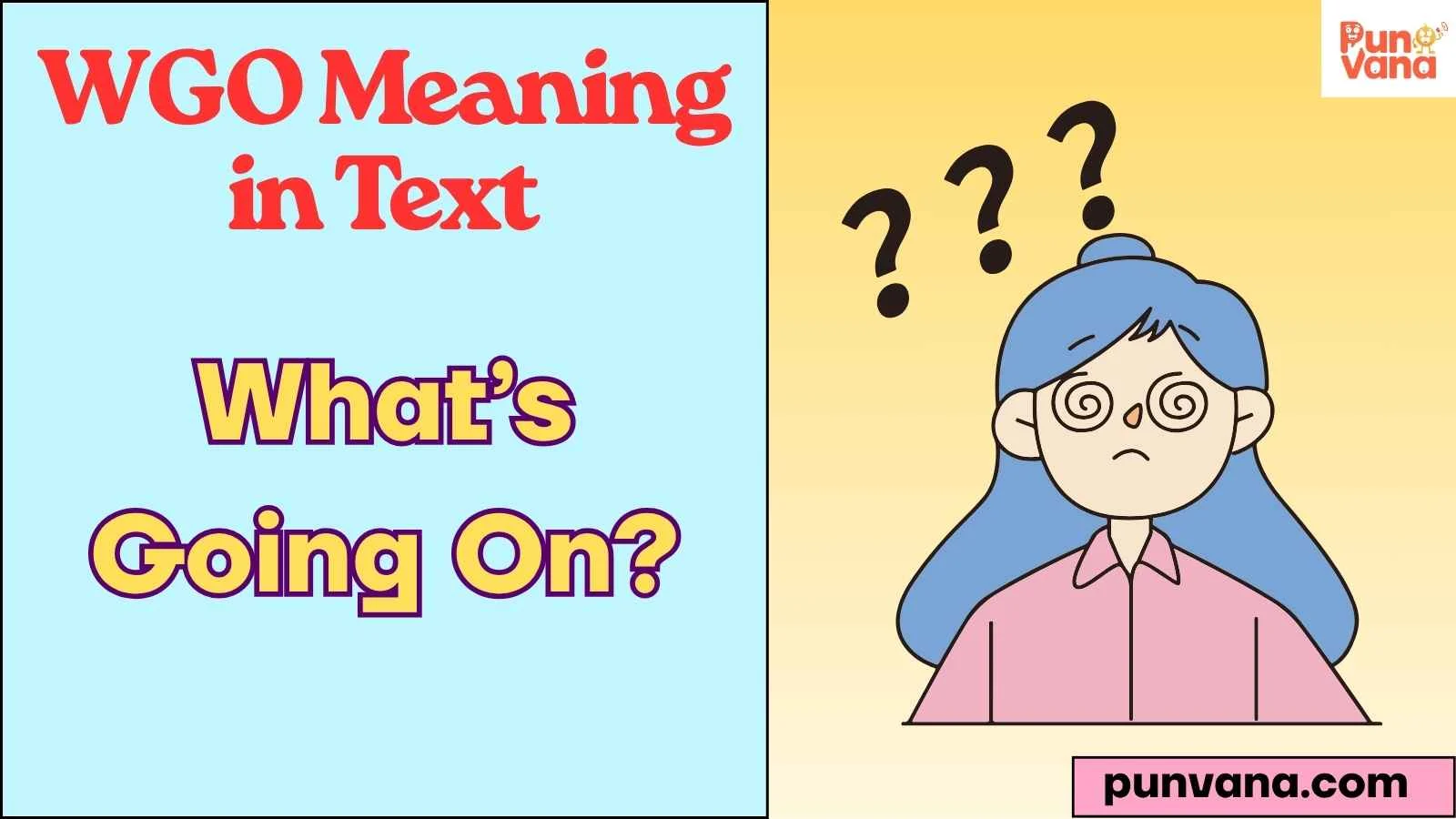
The WGO meaning in text is commonly understood as “What’s going on?” It can be used as a quick way to ask someone what they are doing, what is happening, or what the current situation is.
However, because WGO is not one of the most universally recognized texting abbreviations, its exact meaning can depend on the conversation and the person using it.
That context matters. A message from a close friend may have a completely different tone from the same abbreviation used in a group chat, gaming conversation, or casual social-media message. 📱
In this guide, you will learn what WGO means in text, how people use it, what it can imply, how to respond, and how it compares with similar abbreviations.
You will also see practical examples so you can understand the expression naturally rather than simply memorizing a definition.
What Does WGO Mean in Text? 📱
The most common casual interpretation of WGO in texting is:
WGO = What’s Going On?
It is generally used as a quick question about a situation, activity, or current event.
For example:
Person A: “Hey, WGO?”
Person B: “Not much. Just watching a movie.”
Here, WGO functions much like “What’s going on?”, “What’s happening?”, or sometimes “What are you up to?”
The abbreviation saves time and fits the fast, informal nature of digital conversations.
However, there is an important point to remember: WGO is relatively uncommon compared with more established texting abbreviations. Some people may use it differently, and others may not recognize it immediately.
So, when interpreting WGO, always consider the surrounding words.
Quick answer
| Abbreviation | Common meaning | Typical use |
|---|---|---|
| WGO | What’s going on? | Casual texting |
| WGO? | What’s going on? | Asking about a situation |
| WGO rn? | What’s going on right now? | Asking about a current situation |
| Hey, WGO? | Hey, what’s going on? | Casual check-in |
If the abbreviation appears in an unusual context, asking the sender for clarification is the safest approach.
Why Do People Use WGO in Texting? 💬
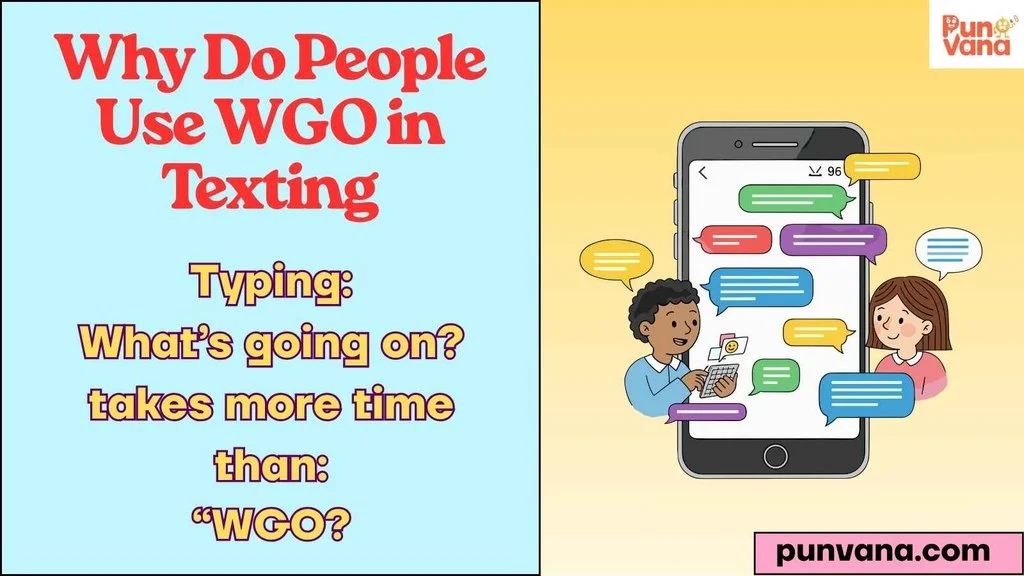
People use abbreviations because texting rewards speed, simplicity, and convenience.
Typing:
“What’s going on?”
takes more time than:
“WGO?”
Although the difference is small, abbreviated language has become common in fast-moving digital conversations.
There are several reasons someone might use WGO.
It is quick
Text messages are often written rapidly. Short forms allow people to communicate without typing every word.
It feels casual
WGO can make a conversation sound relaxed rather than formal.
Compare:
“What is currently happening?”
with:
“WGO?”
The second version feels much more natural in a casual chat.
It can start a conversation
A person may send WGO simply because they want to reconnect.
For example:
“Hey! WGO?”
This can be a simple conversation opener.
It fits mobile communication
People frequently communicate through phones, social platforms, gaming chats, and messaging apps. Short expressions fit naturally into these environments.
It can ask about a situation
WGO is not always asking what someone personally is doing. It can also refer to something happening around them.
For example:
“Everyone is leaving. WGO?”
Here, the sender wants to know what is happening.
WGO Meaning Can Depend on Context 🔎
One of the biggest mistakes people make with texting abbreviations is assuming that every abbreviation has one fixed meaning.
Digital slang does not always work that way.
A phrase can change meaning depending on:
- The surrounding words
- The relationship between the speakers
- The platform
- The topic
- The tone of the conversation
- The person’s individual texting habits
For example:
“WGO?”
might mean:
“What’s going on?”
But:
“WGO with the meeting?”
could be interpreted as asking what is happening with a particular event.
Likewise:
“WGO 😂”
may sound playful or curious.
Meanwhile:
“WGO???”
could communicate stronger confusion or urgency.
The letters remain the same, but punctuation and context can change the feeling.
A useful rule
If WGO appears by itself, “What’s going on?” is a reasonable interpretation.
If it appears inside a longer sentence, use the surrounding conversation to determine the intended meaning.
Examples of WGO in Text Messages 💬
Seeing real examples makes texting abbreviations much easier to understand.
Example 1: Checking on a friend
Alex: “Hey, WGO?”
Sam: “Nothing much. Just doing homework.”
Meaning:
“Hey, what’s going on?”
Example 2: Asking about plans
Mia: “WGO tonight?”
Liam: “I think we’re going to the mall.”
Depending on the sender, this may be understood as asking what is happening or what plans are happening that evening.
Example 3: Asking about a strange situation
Jordan: “Everyone is standing outside. WGO?”
Taylor: “The fire alarm went off.”
Here, WGO clearly means something like:
“What’s going on?”
Example 4: Casual conversation
Chris: “Yo WGO?”
Max: “Just gaming.”
The abbreviation works as a casual conversation starter.
Example 5: Checking on a group
Ella: “WGO with the group project?”
Noah: “We finished most of it.”
Here, the meaning is related to the status of a situation.
Example 6: Showing confusion
Sam: “Why is everyone leaving?”
Alex: “WGO??”
The repeated question marks can suggest surprise or confusion.
Example 7: Asking what is happening right now
“WGO rn?”
Here, rn means “right now.”
So the message asks what is happening at the moment.
Example 8: A playful check-in
“Heyyy WGO? 😂”
The extra letters and emoji make the message feel more playful and informal.
What Tone Does WGO Have? 😊
The tone of WGO is generally casual and conversational.
It is not normally associated with formal writing.
You would be much more likely to see it in:
- Text messages
- Casual chats
- Social media messages
- Group conversations
- Gaming chats
- Informal online communities
You would usually avoid it in:
- Academic essays
- Formal emails
- Business reports
- Official applications
- Professional documents
For example, texting a friend:
“WGO?”
is perfectly understandable in an informal setting.
But writing:
“WGO?”
in a formal school assignment would not be appropriate.
Instead, write:
“What is happening?”
or
“What is going on?”
WGO can sound friendly
When sent between friends, WGO may feel like a quick check-in.
“Hey WGO?”
can communicate curiosity without sounding overly serious.
WGO can also sound urgent
Punctuation matters.
“WGO?”
sounds normal.
“WGO???”
can suggest confusion, surprise, or concern.
The context determines which interpretation makes the most sense.
Is WGO the Same as “What’s Going On?” 🤔
In many casual conversations, yes.
WGO is commonly interpreted as a shortened version of “What’s going on?”
However, it is worth distinguishing between meaning and popularity.
The phrase “What’s going on?” is extremely common in everyday English.
The abbreviation WGO is much less standardized than many familiar texting abbreviations.
That means some readers may immediately understand it, while others may wonder what it means.
For example, abbreviations such as LOL, BRB, or IDK have become widely recognizable in online communication.
WGO does not have the same level of universal recognition.
Therefore, if you use WGO with someone who is unfamiliar with the abbreviation, they may simply ask:
“What does WGO mean?”
That is normal.
The key distinction
“What’s going on?” is standard conversational English.
“WGO” is an informal abbreviation that some people use to shorten that phrase.
🤒WGO vs. Similar Texting Abbreviations
WGO can sometimes be confused with other short forms.
Understanding the differences can prevent misunderstandings. 👀
| Abbreviation | Common meaning | Main purpose |
| WGO | What’s going on? | Ask about a situation |
| WYD | What are you doing? | Ask about someone’s activity |
| WYA | Where are you? | Ask about location |
| IDK | I don’t know | Express uncertainty |
| BTW | By the way | Introduce another point |
| RN | Right now | Refer to the current moment |
| OMG | Oh my God | Express surprise or excitement |
| LOL | Laughing out loud | Show amusement |
| LMK | Let me know | Ask someone to provide information |
| HBU | How about you? | Return a question |
These abbreviations may appear together.
For example:
“WGO? WYD rn?”
A reader could interpret this as:
“What’s going on? What are you doing right now?”
The exact wording can vary depending on the conversation.
WGO vs. WYD: What Is the Difference? 📲
One particularly important comparison is WGO vs. WYD.
They may appear similar because both can be used to start conversations.
WGO
WGO = What’s going on?
It generally asks about a situation or what is happening.
Example:
“Everyone’s outside. WGO?”
The sender wants to know what is happening.
WYD
WYD = What are you doing?
It generally asks about a person’s current activity.
Example:
“WYD?”
The sender wants to know what the other person is doing.
Simple distinction
Think of it this way:
WGO → What is happening?
WYD → What are you doing?
There can be overlap in casual conversation, but the basic focus differs.
How to Respond to “WGO” 💬
If someone sends you “WGO?”, your response depends on what is happening.
You do not need a complicated answer.
If nothing is happening
You could say:
“Not much.”
or:
“Nothing really.”
If you are busy
You might respond:
“Just finishing my homework.”
If something interesting is happening
You could say:
“We’re getting ready to go out.”
If you are unsure what they mean
You can simply ask:
“Do you mean what’s going on?”
That is especially useful when the abbreviation appears without enough context.
If they are asking about a specific event
Give them the relevant information.
For example:
“The game starts in 20 minutes.”
The best response is always connected to the context of the conversation.
Is WGO Used by Everyone? 🌐
No. Texting vocabulary varies widely between people and communities.
Some abbreviations become extremely popular, while others remain relatively uncommon.
Several factors influence whether someone recognizes WGO.
Age and communication habits
People who frequently use texting shorthand may recognize more abbreviations than someone who prefers complete sentences.
Social groups
Different friend groups can develop their own vocabulary.
An abbreviation that feels obvious within one group may confuse another group.
Online communities
Gaming communities, social platforms, messaging groups, and other digital spaces often develop specialized shorthand.
Personal preference
Some people love abbreviations.
Others rarely use them.
For example:
Person A: “WGO?”
Person B: “Sorry, what does that mean?”
There is nothing unusual about this exchange.
Not every abbreviation has universal recognition.
The Origin and Evolution of WGO 🕰️
Texting abbreviations developed as digital communication became faster and more widespread.
Early internet communities, chat rooms, instant messaging services, SMS texting, and later social platforms all encouraged people to communicate efficiently.
People began shortening common phrases to save time and typing effort.
Examples include:
- LOL
- BRB
- OMG
- IDK
- BTW
- WYD
- WYA
- LMK
WGO fits into this broader pattern of shortening conversational expressions.
Instead of writing:
“What’s going on?”
a person can type:
“WGO?”
The exact history of an abbreviation like WGO is difficult to pin to one specific person or moment because online slang typically develops organically. Different communities may independently create or adopt similar shorthand.
That is why it is better to understand WGO as part of the broader evolution of informal digital language, rather than treating it as a term with one definitive inventor.
How WGO Works in Different Conversations
The same abbreviation can have slightly different conversational functions.
WGO as a greeting
“Hey WGO?”
Here, the sender may simply be checking in.
WGO as a question
“WGO?”
This is the most straightforward use.
WGO as a request for an update
“WGO with the plans?”
The sender wants information about a particular situation.
WGO as a reaction
“WGO??”
The sender may be confused or surprised.
WGO with other abbreviations
“WGO rn? WYD?”
The sender is using multiple forms of shorthand to keep the conversation quick.
The important thing is not to interpret the abbreviation in isolation when additional context is available.
WGO in Social Media and Online Chats 📱
Short forms are especially common in fast-paced online communication.
On social platforms, users often prefer short messages because conversations move quickly.
A person might write:
“WGO in the comments?”
or:
“WGO here?”
The exact meaning can depend heavily on the community.
Social media also encourages playful language. Users may combine abbreviations with:
- Emojis 😂
- Repeated letters
- Capitalization
- Question marks
- Slang
- GIFs
- Memes
For example:
“WGOOO 😂”
is not necessarily a formal abbreviation anymore. The extended spelling can add personality and emotion.
Likewise:
“WGO???”
may communicate more urgency than:
“WGO?”
Digital communication is not only about the literal words. Punctuation, formatting, timing, and emojis also carry meaning.
WGO in Group Chats 👥
Group chats provide another interesting context.
Imagine several people are talking about an event.
Someone joins late and writes:
“WGO?”
They probably want a quick explanation of what has happened.
Another person might reply:
“We’re waiting for everyone to arrive.”
In this situation, WGO works as a request for an update.
Group chats can move quickly, so abbreviations can be particularly useful.
However, group conversations can also create confusion because several topics may be happening simultaneously.
If WGO seems ambiguous, the best response is to ask for clarification.
Common Mistakes When Interpreting WGO ❌
Even simple abbreviations can create misunderstandings.
Here are several mistakes to avoid.
Assuming every abbreviation has one universal definition
Slang changes between communities.
Do not assume your interpretation is automatically correct.
Ignoring the surrounding conversation
The words around WGO often provide the strongest clue.
Treating casual shorthand as formal English
WGO belongs primarily to informal digital communication.
Overanalyzing a simple message
Sometimes “WGO?” simply means:
“What’s going on?”
There may be no hidden message.
Assuming the sender is upset
Punctuation can change tone, but a short message is not automatically angry.
For example:
“WGO?”
does not necessarily mean the person is annoyed.
Always consider the broader conversation.
How to Use WGO Naturally ✍️
If you want to use WGO yourself, keep it in situations where casual language is appropriate.
Good situations
WGO can work in:
- Friendly text messages
- Casual group chats
- Informal online conversations
- Social-media messages
- Conversations with people who understand texting shorthand
Situations to avoid
Avoid it in:
- Formal school assignments
- Professional correspondence
- Official documents
- Formal applications
- Academic writing
Instead of:
“WGO?”
a formal message might say:
“Could you tell me what is happening?”
The right choice depends on your audience.
WGO Example Sentences for Everyday Texting
Here are additional examples that demonstrate different contexts.
| Text example | Likely interpretation |
| “Hey, WGO?” | What’s going on? |
| “WGO tonight?” | What’s happening tonight? |
| “WGO with the meeting?” | What is happening with the meeting? |
| “WGO??” | What’s going on? / What happened? |
| “WGO rn?” | What’s going on right now? |
| “Yo, WGO?” | Casual check-in |
| “WGO here?” | What’s happening here? |
| “Okay… WGO?” | Asking for an explanation |
| “Everyone is laughing. WGO?” | Asking what caused the reaction |
| “WGO with those plans?” | Asking for an update |
These examples show why context is so important.
Can WGO Have Other Meanings? 🤔
Yes.
This is an important point when discussing abbreviations.
An acronym or abbreviation can have different meanings in different environments. A term used in texting may not mean the same thing in another field.
For example, an abbreviation might appear as:
- A company abbreviation
- A technical term
- An organization name
- A gaming term
- A community-specific expression
- A personal shorthand
Therefore, if you encounter WGO outside a casual text conversation, do not automatically assume it means “What’s going on?”
Look at the context first.
If the surrounding conversation is clearly casual texting, the conversational interpretation is much more likely.
If it appears in a technical, professional, or specialized context, another meaning may be intended.
WGO and Digital Communication Etiquette 💡
Using slang effectively is partly about understanding your audience.
A good communicator does not simply know abbreviations. They know when to use them.
With close friends
Short forms can feel natural.
“WGO?”
With someone you barely know
A complete phrase may be clearer.
“Hey, what’s going on?”
In a formal setting
Use standard language.
“Could you please provide an update?”
This distinction matters because clarity is more important than saving a few keystrokes.
When someone might not understand WGO, spelling out the phrase can prevent unnecessary confusion.
FAQs:
What does WGO mean in text?
WGO commonly means “What’s going on?” in casual texting. It can be used to ask what is happening or to check in with someone.
Is WGO a common texting abbreviation?
WGO is less standardized and less universally recognized than abbreviations such as LOL, IDK, or BRB. Some people may understand it immediately, while others may not.
What does WGO mean in a chat?
In a casual chat, WGO will often be interpreted as “What’s going on?” The surrounding conversation can help confirm the intended meaning.
Is WGO the same as WYD?
Not exactly. WGO commonly asks what is happening, while WYD means “What are you doing?” and focuses more directly on someone’s activity.
How should I respond to WGO?
Respond according to the situation. You could say “Not much,” “Just doing homework,” “We’re heading out,” or provide an update about whatever is happening.
Final Thoughts:
Understanding WGO meaning in text is easier when you look beyond the three letters.
In casual digital communication, WGO commonly means “What’s going on?” People may use it to ask about a situation, check in with someone, request an update, or simply start a conversation.
At the same time, WGO is not as universally established as many other texting abbreviations. That means context matters. The people involved, the platform, the surrounding words, punctuation, and conversation topic can all influence the intended meaning.
If you receive “WGO?”, a simple interpretation is usually:
“What’s going on?”
And if the meaning is unclear, there is nothing wrong with asking the sender what they intended.
Digital language changes constantly. Learning common abbreviations can make texting easier, but understanding context and tone is even more important. 📱✨

I’m the writer behind Punvana, where I make confusing words, slang, abbreviations, and text meanings simple and easy to understand. I love breaking down language into clear, practical explanations so you can quickly find the meaning and use of any term with confidence.