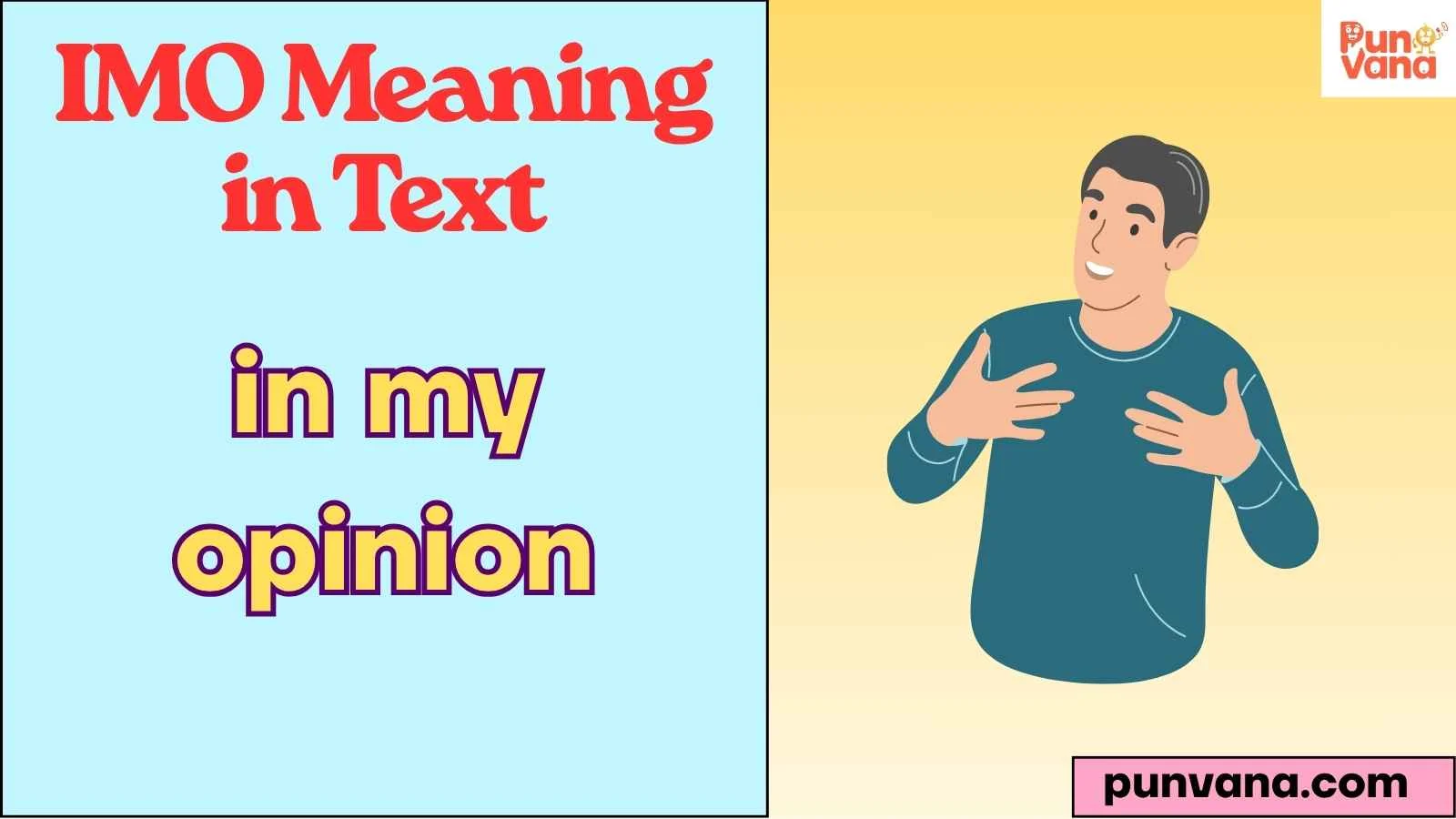
IMO meaning in text is “in my opinion.” People use IMO in texts, chats, comments, social media posts, forums, and online conversations when they want to share a personal view or judgment. It usually signals that the statement that follows is the speaker’s opinion rather than an established fact.
For example, someone might text, “IMO, this is the best movie of the year.” Here, IMO makes it clear that the person is sharing a personal opinion.
This small abbreviation is common because it saves time while keeping conversations casual and natural. If you have seen IMO in a message and wondered whether it has another meaning, this guide explains its meaning, origin, usage, examples, tone, related abbreviations, and common mistakes. 😊
IMO Meaning in Text at a Glance 📱
The most common meaning of IMO in texting and online communication is:
IMO = In My Opinion
It is used when someone wants to express what they personally think about something.
| Abbreviation | Meaning | Typical Use | Tone |
|---|---|---|---|
| IMO | In My Opinion | Sharing a personal view | Casual |
| IMHO | In My Humble Opinion | Sharing an opinion politely | Casual |
| IMHO | In My Honest Opinion | Giving a personal view | Casual |
| TBH | To Be Honest | Giving an honest reaction | Casual |
| I think | Personal belief | Everyday conversation | Neutral |
| Personally | Personal viewpoint | More direct expression | Neutral |
So, when someone writes “IMO,” they are usually saying, “This is how I see it.”
Simple example
Text:
“IMO, pizza is better than burgers.”
Meaning:
“In my opinion, pizza is better than burgers.”
The statement is presented as a personal preference rather than a universal fact.
What Does IMO Mean in a Text Message? 💬
In a text message, IMO means “in my opinion.”
It tells the reader that the next statement reflects the sender’s personal thoughts, preferences, or judgment.
For example:
- “IMO, that restaurant is worth trying.”
- “IMO, you should take the earlier flight.”
- “IMO, the first season was better.”
- “IMO, blue looks better.”
- “IMO, this is the easiest option.”
In each example, the sender is not necessarily claiming that everyone should agree. They are simply explaining their own perspective.
This distinction can be important in online conversations. Without a phrase like IMO, a sentence can sometimes sound like a firm statement of fact.
Compare these:
“This is the best phone.”
versus
“IMO, this is the best phone.”
The second version sounds more personal and subjective.
Why do people use IMO?
People use IMO for several simple reasons:
- ⏱️ It saves time while typing.
- 💬 It clearly marks an opinion.
- 🙂 It keeps conversations casual.
- 🧠 It separates personal views from facts.
- 📱 It fits naturally into texting and social media.
IMO Origin and History 🕰️
The abbreviation IMO developed from the phrase “in my opinion.” Like many internet abbreviations, it became popular as online communication moved toward shorter, faster messages.
Early internet communities, chat rooms, forums, and messaging platforms encouraged users to communicate quickly. Abbreviations became useful because they allowed people to express familiar phrases with fewer characters.
IMO belongs to the same family of internet shorthand as:
- BTW — by the way
- FYI — for your information
- TBH — to be honest
- IDK — I don’t know
- LOL — laugh out loud
- IMHO — in my humble opinion
- IRL — in real life
Over time, IMO became a familiar part of informal digital communication.
Did IMO start as texting slang?
Not exactly.
Its development is more closely connected with the broader culture of online communication, including message boards, chat rooms, and internet discussions. Text messaging later helped make abbreviations like IMO even more familiar.
Today, you can see IMO in many forms of casual digital communication, including:
- Text messages
- Group chats
- Social media comments
- Online forums
- Gaming chats
- Community discussions
- Emails between friends
- Review discussions
The abbreviation has remained useful because the underlying phrase is extremely common.
How to Use IMO Correctly in Texts 📲
Using IMO is simple. Put it before the opinion you want to express.
Basic structure
IMO + opinion
For example:
“IMO, this book is worth reading.”
Here, the writer identifies the following statement as a personal opinion.
You can also use IMO in the middle of a sentence:
“The second option is, IMO, much easier.”
This style is especially common in online discussions.
Examples of IMO in everyday texting
Example 1: Food 🍕
“IMO, homemade pizza tastes better.”
Meaning: The sender personally prefers homemade pizza.
Example 2: Movies 🎬
“IMO, the ending was too long.”
Meaning: The sender personally thinks the ending was too long.
Example 3: Travel ✈️
“IMO, summer is the best time to visit.”
Meaning: The sender personally prefers visiting during summer.
Example 4: Shopping 🛍️
“IMO, the black one looks better.”
Meaning: The sender personally prefers the black option.
Example 5: School 📚
“IMO, the first chapter is easier.”
Meaning: The sender thinks the first chapter is easier.
Example 6: Gaming 🎮
“IMO, this character is underrated.”
Meaning: The sender personally believes the character does not get enough recognition.
IMO Examples in Different Conversations 🌎
The meaning of IMO stays the same, but the way people use it can change depending on the conversation.
IMO in friendly chats
Friends often use IMO when discussing preferences.
Friend 1:
“Which restaurant should we try?”
Friend 2:
“IMO, the Italian place is better.”
The sender is simply giving a recommendation based on personal preference.
IMO in social media comments
Someone might comment:
“IMO, the original version is still better.”
This makes the comment sound like a personal viewpoint rather than an objective claim.
IMO in online discussions
A person might write:
“IMO, the problem is more complicated than it looks.”
Here, IMO signals that the statement represents the writer’s interpretation.
IMO in group chats
A group member might say:
“IMO, we should leave earlier.”
The abbreviation makes the suggestion feel like a personal recommendation.
IMO in gaming
Gamers may use it when discussing characters, maps, weapons, strategies, or updates:
“IMO, the new map is more fun.”
The sender is sharing a personal assessment.
IMO in reviews
Someone might write:
“IMO, the service was better than the food.”
This clearly communicates a subjective judgment.
IMO vs IMHO vs TBH: What’s the Difference? 🤔
Several texting abbreviations can introduce personal opinions, but their tone and purpose can differ.
IMO — In My Opinion
IMO is the straightforward option.
“IMO, this is the better choice.”
It simply introduces a personal opinion.
IMHO — In My Humble Opinion
IMHO traditionally means “in my humble opinion.”
“IMHO, the older version was better.”
It can sound slightly more modest or playful.
However, people sometimes interpret IMHO as “in my honest opinion.” The exact expansion can depend on the speaker.
TBH — To Be Honest
TBH focuses more on honesty or frankness.
“TBH, I didn’t really enjoy it.”
It can introduce an opinion, but its main purpose is to emphasize honesty.
Quick comparison
| Term | Full Form | Main Purpose |
|---|---|---|
| IMO | In My Opinion | Introduces a personal opinion |
| IMHO | In My Humble Opinion | Introduces an opinion with a modest tone |
| TBH | To Be Honest | Signals an honest or frank statement |
| IIRC | If I Recall Correctly | Signals uncertain memory |
| AFAIK | As Far As I Know | Signals limited knowledge |
| FWIW | For What It’s Worth | Offers information or an opinion that may be useful |
Knowing these differences can make online conversations much easier to understand.
Is IMO Formal or Informal? 🗣️
IMO is primarily informal.
It works well in:
- Text messages
- Social media
- Group chats
- Forums
- Casual emails
- Gaming conversations
- Online comments
For professional or formal writing, it is usually better to write “in my opinion” instead.
Casual example
“IMO, this plan could work.”
More formal version
“In my opinion, this plan could work.”
The meaning is essentially the same. The difference is register.
Using the full phrase in a formal setting sounds clearer and more professional.
Where should you avoid IMO?
You may want to avoid the abbreviation in:
- Academic essays
- Formal reports
- Legal documents
- Official applications
- Business proposals
- Formal presentations
This does not mean IMO is incorrect. It simply belongs more naturally in informal digital communication.
Does IMO Always Mean “In My Opinion”? 🔍
In ordinary texting and online conversation, IMO overwhelmingly means “in my opinion.”
However, abbreviations can have different meanings in specialized settings. Context always matters.
For example, IMO can refer to things outside texting shorthand in certain professional or technical contexts. But when you see it in a casual message such as:
“IMO, that was hilarious 😂”
the intended meaning is almost certainly “in my opinion.”
How can you identify the meaning?
Look at the surrounding words.
If IMO appears before a personal judgment, preference, recommendation, or interpretation, “in my opinion” is the natural reading.
For example:
“IMO, this color looks better.”
Clearly, the person is sharing an opinion.
Likewise:
“IMO, you should wait.”
The sender is expressing a personal recommendation.
Context removes most ambiguity.
IMO Meaning on Social Media and Online Platforms 📱
IMO is common across many social platforms because online conversations often move quickly.
People use it to introduce:
- Opinions
- Recommendations
- Reviews
- Personal preferences
- Reactions
- Interpretations
- Comparisons
Example social media comments
“IMO, this is the best version.”
“IMO, the first photo looks better.”
“IMO, this trend won’t last.”
“IMO, the original design was cleaner.”
The abbreviation can also soften the tone of a strong statement.
Compare:
“Your idea won’t work.”
with:
“IMO, your idea may need some changes.”
The second sentence presents the thought as a personal viewpoint rather than an absolute judgment.
That does not automatically make the statement polite, but it can make the speaker’s intention clearer.
Common IMO Texting Examples and Meanings ✨
Here are more examples you may encounter in everyday conversations.
| Text Example | Meaning |
|---|---|
| “IMO, this is better.” | In my opinion, this is better. |
| “IMO, you should go.” | In my opinion, you should go. |
| “That was, IMO, the best part.” | That was, in my opinion, the best part. |
| “IMO, the price is fair.” | In my opinion, the price is fair. |
| “IMO, we need more time.” | In my opinion, we need more time. |
| “IMO, this looks great.” | In my opinion, this looks great. |
| “IMO, I’d choose the first one.” | In my opinion, I’d choose the first one. |
| “IMO, that’s a good idea.” | In my opinion, that’s a good idea. |
| “IMO, the ending could be better.” | In my opinion, the ending could be better. |
| “IMO, this is worth trying.” | In my opinion, this is worth trying. |
Short IMO replies
Sometimes the abbreviation appears by itself with a short opinion:
“IMO, yes.”
“IMO, no.”
“IMO, definitely.”
“IMO, the first one.”
These are informal but easy to understand in casual conversations.
Common Mistakes When Using IMO ⚠️
Although IMO is simple, people sometimes misunderstand how it works.
1. Treating IMO as a fact
IMO signals a personal viewpoint.
If someone says:
“IMO, this is the best restaurant.”
they are expressing a preference, not proving that the restaurant is objectively the best.
2. Using IMO in every sentence
Repeating it too often can make a message feel unnatural.
Instead of:
“IMO, this is good. IMO, the price is fine. IMO, the service is great.”
a more natural message would be:
“IMO, this is a great option. The price is fair, and the service is good too.”
3. Using it in highly formal writing
In an academic paper, “in my opinion” or a more precise statement is generally more suitable.
4. Assuming every reader knows abbreviations
If you’re communicating with someone who may not be familiar with internet shorthand, writing the full phrase can avoid confusion.
5. Thinking IMO means agreement
IMO does not mean “I agree.”
Compare:
IMO:
“In my opinion, the second option is better.”
I agree:
“I agree with what you said.”
The first expresses an independent viewpoint. The second indicates agreement with another person’s statement.
IMO in a Conversation: Tone and Meaning 🎯
The tone of IMO depends heavily on the sentence around it.
Friendly tone
“IMO, you absolutely nailed it! 😊”
This expresses a positive personal judgment.
Neutral tone
“IMO, the second option makes more sense.”
This is a straightforward opinion.
Careful or diplomatic tone
“IMO, there might be a simpler way to handle this.”
Here, IMO helps frame a potentially critical suggestion as a personal perspective.
Strong opinion
“IMO, that’s the wrong approach.”
The abbreviation still signals that the statement is subjective, but the wording remains direct.
So, IMO does not automatically make a message polite or soft. The surrounding language determines much of the tone.
IMO vs “I Think”: Are They the Same? 🧠
In many everyday situations, IMO and “I think” serve a similar purpose.
Compare:
“IMO, this movie is worth watching.”
and
“I think this movie is worth watching.”
Both communicate a personal opinion.
The difference is mainly stylistic.
IMO feels more like internet shorthand and is especially common in digital conversations.
I think feels more natural in ordinary spoken English and can be used in both casual and professional contexts.
Which sounds more conversational?
In face-to-face conversation, people normally say:
“I think…”
rather than:
“IMO…”
IMO is primarily a written abbreviation.
When Should You Use IMO? ✅
Use IMO when you want to make it clear that you are sharing your own perspective.
It works particularly well when:
- You are giving a recommendation.
- You are comparing two choices.
- You are reviewing something.
- You are discussing preferences.
- You are responding to a debate.
- You want to clarify that a statement is subjective.
- You are chatting casually online.
Good examples
“IMO, the cheaper option is enough.”
“IMO, that movie deserves more attention.”
“IMO, we should start earlier.”
“IMO, the second design looks cleaner.”
When another phrase may be better
If you are writing a formal document, consider:
- In my opinion
- From my perspective
- I believe
- My view is that
- Based on my experience
The best choice depends on your audience and the level of formality.
FAQs:
What does IMO mean in text?
IMO means “in my opinion.” It is an informal abbreviation used in texts, chats, comments, and online conversations to introduce a personal viewpoint.
What does IMO mean on social media?
On social media, IMO usually means “in my opinion.” People use it when sharing personal thoughts, preferences, reviews, or judgments.
Is IMO rude?
IMO is not inherently rude. It simply identifies a statement as the speaker’s opinion. The tone depends on the words used around it.
What is the difference between IMO and IMHO?
IMO means “in my opinion,” while IMHO traditionally means “in my humble opinion.” Both introduce personal viewpoints, although IMHO can carry a more modest or playful tone.
Can I use IMO in formal writing?
IMO is mainly an informal abbreviation. In formal writing, spelling out “in my opinion” is usually clearer and more appropriate.
Final Thoughts:
Understanding IMO meaning in text is simple: IMO means “in my opinion.” It is a common piece of internet shorthand used to introduce a personal thought, preference, recommendation, or judgment.
You will most often see it in texts, chats, social media comments, forums, and other casual online conversations. It helps readers understand that the statement represents an individual’s perspective rather than an objective fact.
So, the next time someone writes “IMO,” you can read it naturally as “in my opinion.” 💬
If you enjoy learning what modern text abbreviations mean, explore more meaning-in-text guides to quickly understand the shorthand people use online every day. 🚀

I’m the writer behind Punvana, where I make confusing words, slang, abbreviations, and text meanings simple and easy to understand. I love breaking down language into clear, practical explanations so you can quickly find the meaning and use of any term with confidence.